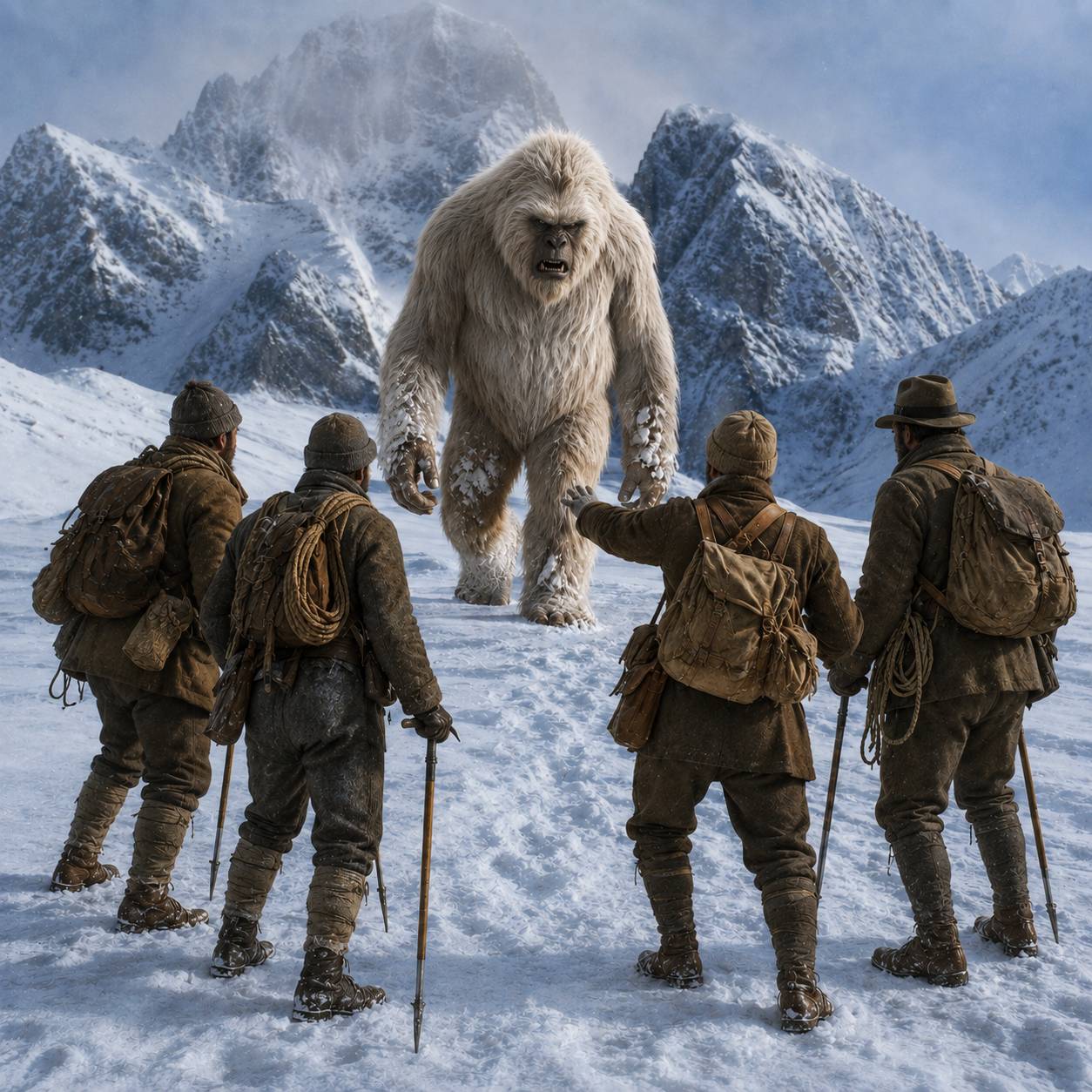
The Abominable Snowman, more properly known as the Yeti, is one of the world’s most famous legendary creatures. For centuries, stories have described a large, mysterious, humanlike animal living among the snow-covered mountains of the Himalayas, particularly in Nepal, Tibet, Bhutan, and nearby regions of Asia.
Able to walk on two legs, although some reports suggest it can move on all fours. Extremely strong and adapted to cold, high-altitude environments. Shy and elusive, usually avoiding people. Associated with large, unusual footprints in snow or mud.

Western popular culture often imagines the Abominable Snowman as a gigantic, white-furred creature wandering permanently through deep snow. However, traditional Himalayan stories are more complicated. Local traditions describe several different mysterious wild beings, and not everyone is a giant white ape.
The creature’s original local names include variations of Yeti, although the meanings and spellings differ among Himalayan languages. The famous English name “Abominable Snowman” became popular after reports from British expeditions in the Himalayas during the 1920s.
A misunderstanding or loose translation of a local term reportedly contributed to the dramatic name. Once newspapers began using “Abominable Snowman,” the creature became an international sensation.

One of the main reasons the Yeti became famous was the discovery of large footprints in the snow. Explorers climbing in the Himalayas sometimes reported finding tracks that appeared to resemble enormous human footprints.
Some were said to be much larger than an ordinary person’s foot and to continue for long distances across isolated mountain regions. However, there is an important problem with interpreting tracks in snow.
A normal animal footprint can change dramatically after: Snow begins melting. The sun enlarges the edges of the track. Several prints overlap. Wind partially fills in or reshapes the print. Ice melts and then refreezes. A series of ordinary animal tracks can therefore sometimes look surprisingly large and humanlike.
One of the most famous pieces of Yeti evidence came from British mountaineer Eric Shipton. In 1951, while exploring the Everest region, Shipton photographed a large footprint in the snow. The photograph showed what appeared to be a single, enormous print with several toe-like projections.
The image became one of the most famous photographs in cryptozoology. Supporters argued that the track showed evidence of an unknown large creature. Skeptics suggested that the footprint might have been altered by melting snow or could have originated from a known animal.
The photograph remains intriguing, but it has never been accepted as proof that a Yeti exists. During the 1950s, the search for the Abominable Snowman became extremely popular. Mountaineers, explorers, journalists, and scientists organized expeditions into the Himalayas. Some collected: Hair samples. Footprints.
Stories from local inhabitants. Supposed Yeti bones. Skins and other physical objects. The idea that an unknown giant primate might be living in one of the most remote mountain regions on Earth fascinated the public.
At that time, much of the Himalayas remained extremely difficult to explore. Vast areas contained deep snow, dangerous cliffs, glaciers, forests, and isolated valleys. This led some people to believe that an unknown large animal could possibly remain hidden.
Several monasteries in the Himalayan region possessed objects said to be connected with Yetis. Perhaps the most famous were supposed Yeti scalps. Some Western explorers examined these objects, hoping they would provide physical proof.
Later scientific examinations indicated that at least some supposed Yeti relics were made from the skins or fur of known animals. In some cases, unusual headpieces were apparently manufactured from animal hides. Nevertheless, these relics helped increase worldwide interest in the mystery.
Another famous object was a supposed Yeti hand associated with a monastery in Nepal. The hand attracted international attention, and a complicated story developed involving explorers and the removal of one of the supposed fingers for scientific examination.
Eventually, testing indicated that the remains were human rather than belonging to an unknown ape-like creature. The incident became one of the strangest chapters in Yeti history.
Could the Yeti be an unknown animal?
Some believers have proposed that the Yeti could represent an undiscovered species of large primate. Possible theories have included:
1. A surviving giant ape. One of the most popular theories connected the Yeti with Gigantopithecus, an extinct giant ape known from fossil remains. Gigantopithecus was enormous compared with modern apes. Because of its size, some researchers and cryptozoologists wondered whether a surviving population could have somehow remained hidden in Asia. However, the evidence currently available indicates that Gigantopithecus became extinct long ago.
There is also no accepted fossil or genetic evidence connecting it to modern Yeti reports. Another thing, there is a belief among many zoologists that Gigantopithecus was so very heavy that the creature would basically walk on all four limbs, but at times could stand upright by supporting much of its weight against a massive strong and lofty tree. While the Abdominable Snowman is reported to be bi-pedal.
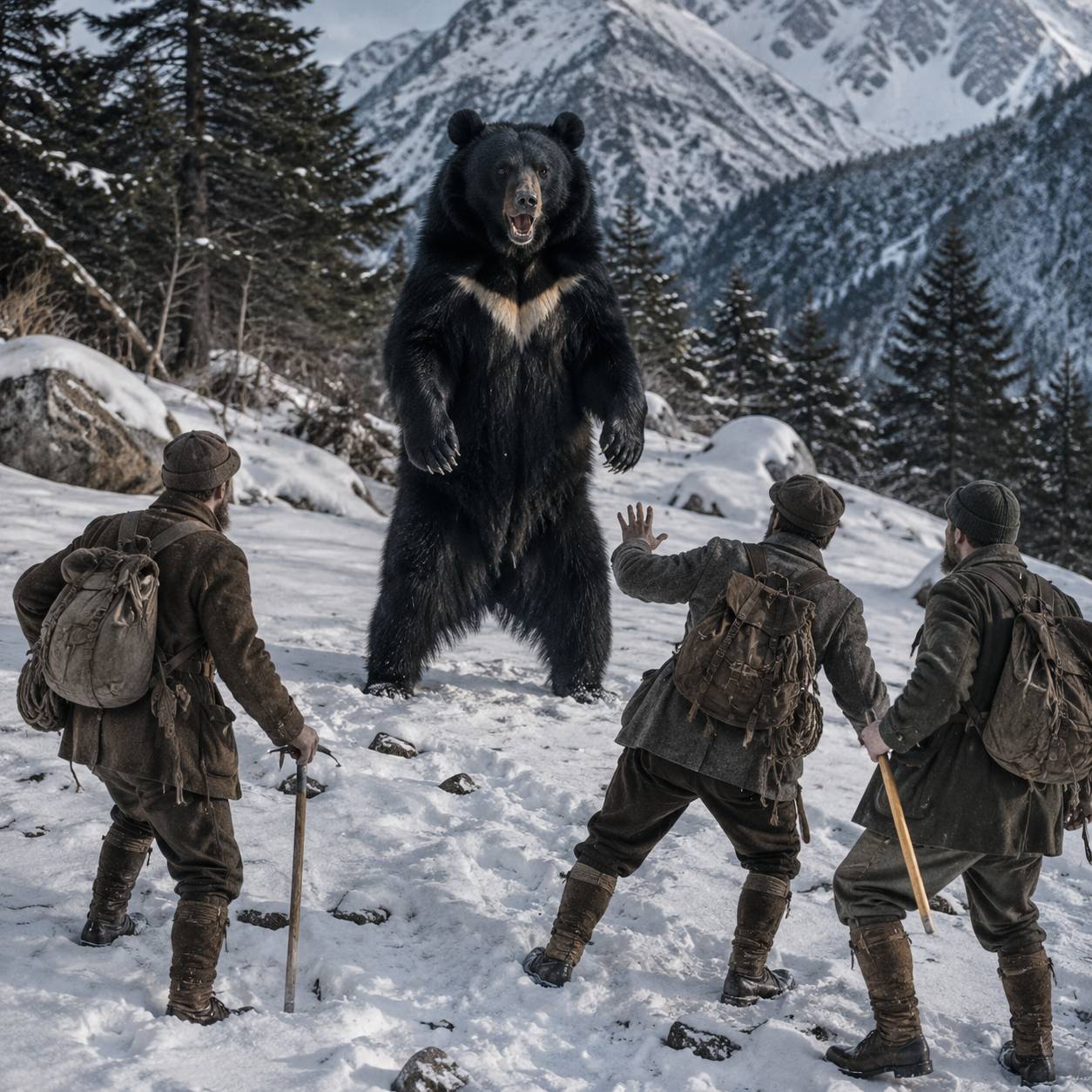
2. An unknown species of bear.
This is one of the leading conventional explanations. The Himalayas contain several bears, including the Himalayan brown bear and the Asian black bear. A bear walking through snow can occasionally leave tracks that look unusual. When the snow melts, separate portions of a bear’s paw print may blend together, producing something that resembles a large human foot. A bear standing on its hind legs can also appear surprisingly humanlike from a distance. Some Yeti sightings may therefore have involved bears.
3. Misidentified known animals.
Other possible explanations include: Bears. Langur monkeys. Wolves. Other mountain animals seen under poor conditions. Shadows or rocks mistaken for living creatures. In the high mountains, visibility can be poor, distances are difficult to judge, and witnesses may see an animal only briefly.
4. Misidentified Bear Footprints
That is a real proposed explanation for at least some Yeti footprints, involving the Asiatic black bear, also called the Himalayan black bear. The basic idea is: Young bears spend considerable time climbing trees, including to get away from large predators, even big bears on the ground “ground bears”, and to avoid other dangers.
During this tree period that might last two years, climbing and gripping branches may cause the feet—particularly the inner toes and claws—to be held or worn in a somewhat unusual position. When such a bear walks through snow, its front and hind footprints can overlap. The thumb is capable of moving toward, touching, and gripping the other digits on the same hand: paw.
The resulting combined track can look surprisingly long, narrow, and vaguely human-shaped. The impression in the snow of a hind paw going over the front paw looks, giving the impression of a hallux; looking just like there is a prominent big toe especially when the bear is traveling slightly uphill especially with the hind paw print extending the overprint backward.
A line of these tracks may therefore create the impression of a large bipedal creature walking across the snow.
The most important point, however, is that the explanation is probably not simply that climbing permanently turns a claw outward and thereby makes a perfect humanlike footprint. That particular version can sometimes be overstated.
The stronger explanation involves a combination of bear anatomy, distorted snow tracks, melting, and overlapping front-and-hind paw prints. A bear walking through deep snow can place a hind foot partly on top of, or close to, the impression left by the front foot.
As the snow melts and the edges collapse, the separate toes and claws can become blurred. What began as two recognizable bear prints can turn into a single elongated impression that looks remarkably like a large humanoid foot.
This is especially interesting because some famous alleged Yeti tracks were found in remote snow-covered terrain, where melting and distortion can dramatically alter the appearance of a track. So, yes—the Asiatic black bear hypothesis is one of the serious natural explanations for some Yeti evidence.
It does not necessarily explain every reported footprint or sighting, but bears are considered a very plausible source for a significant number of Himalayan “Yeti” tracks.

DNA testing and the modern investigation
Modern science has examined a number of hair, bone, tooth, and skin samples claimed to be connected with the Yeti.
Many samples have turned out to belong to known animals, particularly bears. Some supposed Yeti remains have also been found to be from ordinary domestic animals or humans.This does not necessarily explain every historical report, but it means that, so far, no scientifically verified physical specimen has established the existence of an unknown Yeti species.
No confirmed: Body. Skeleton. DNA from an unknown large primate. Clear biological specimen. None of these has yet been produced.
Is the Yeti the same as Bigfoot?
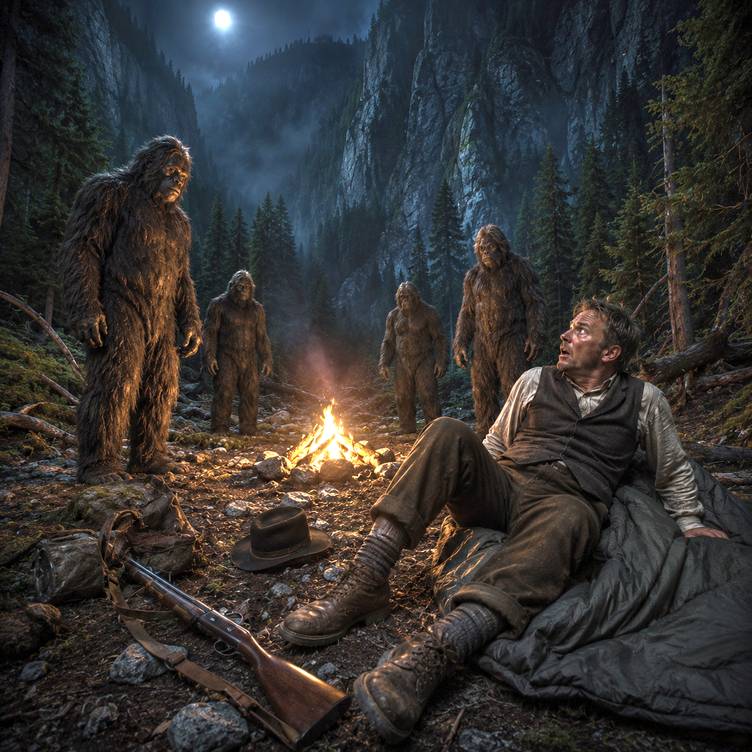
The Yeti and Bigfoot are often compared. Both are described as: Large. Hair-covered. Humanlike. Elusive. Associated with mysterious footprints. However, they belong to different geographical and cultural traditions. Bigfoot, or Sasquatch, is primarily associated with North America, especially the forests and mountains of the Pacific Northwest.
The Yeti belongs to the Himalayan region. Some cryptozoologists believe they could represent related unknown primates. Others believe both legends are mainly based on misidentified animals, folklore, exaggerated stories, and occasional hoaxes.
There is currently no accepted scientific evidence proving the existence of either creature.
The mystery remains
The most reasonable scientific position today is that the Yeti has not been proven to exist as an unknown species. Many alleged Yeti footprints and biological samples have been explained as bears or other known animals.
Yet the legend remains one of the greatest mysteries of cryptozoology. Some reports are difficult to investigate because they occurred in remote places, involved brief sightings, or happened decades ago. Whether the Yeti is a misunderstood bear, a collection of ancient legends, an occasional misidentification—or something genuinely undiscovered—remains part of its enduring fascination.
The Abominable Snowman continues to stand alongside Bigfoot and the Loch Ness Monster as one of the world’s most famous legendary creatures. Unlike a creature invented entirely for modern entertainment, however, the Yeti mystery is rooted in the mountains, traditions, and stories of the Himalayan peoples, giving the legend a history that reaches back long before Western explorers began searching for footprints in the snow.
The Yeti mystery survives because the Himalayas are genuinely enormous and difficult to explore. The region contains: Some of the highest mountains on Earth. Deep forests. Remote valleys. Dangerous glaciers. Severe weather.
Areas with relatively little human activity. The idea of an undiscovered creature surviving in such a landscape remains exciting. In addition, the Yeti is not simply a modern monster story.
It is connected with older Himalayan traditions and beliefs, which makes the subject more historically interesting than many modern cryptid legends.
It is important to remember that new species are still discovered. Scientists continue to find previously unknown animals, particularly small creatures, insects, fish, reptiles, and occasionally mammals.
But discovering a completely unknown large ape-like animal would be much more difficult to explain because such an animal would likely leave substantial evidence, including: Bones. DNA. Droppings. Hair.
Clear photographs. Repeatedly documented tracks. Evidence of a breeding population. After many decades of expeditions and scientific investigation, such evidence has not yet been conclusively found.