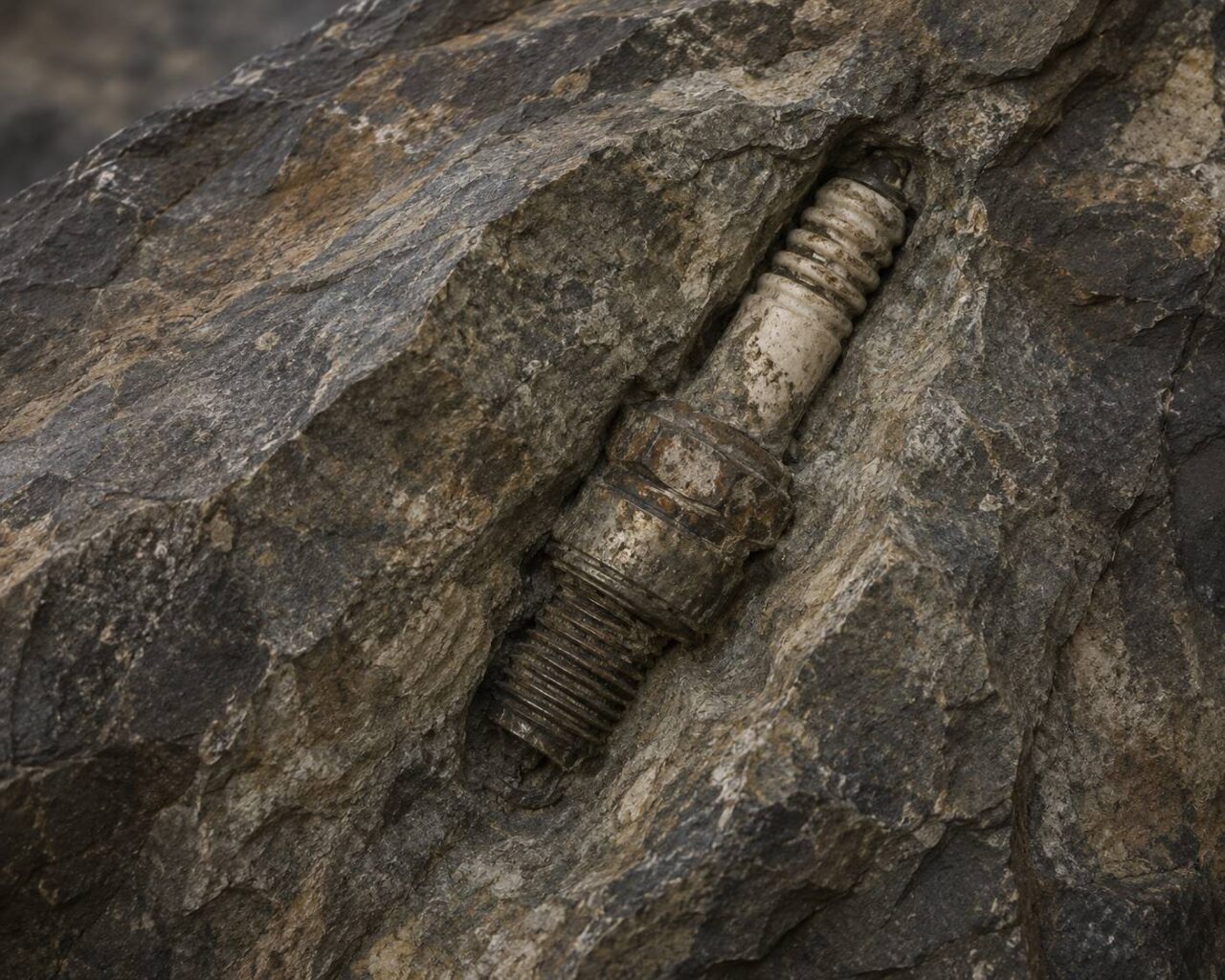
Claims of artifacts found inside ancient rocks or coal are often presented as evidence that humans (or advanced civilizations) existed millions of years ago. These are usually called “out-of-place artifacts” (OOPArts). The most famous cases have been investigated extensively, and none are generally accepted by geologists, archaeologists, or paleontologists as genuine ancient human-made objects embedded in rocks of the claimed age. Here are some of the best-known examples and what is actually known about them.
1. The Coso Artifact (California, 1961)
Often claimed to be: A 500,000-year-old spark plug found inside solid rock.
In 1961, rock collectors Wallace Lane, Virginia Maxey, and Mike Mikesell made a strange discovery near the Coso Mountains of California. Hidden inside a hard, stone-like shell was an object that X-rays revealed looked remarkably like a spark plug. Before long, stories began circulating that it had been found inside rock hundreds of thousands of years old—a discovery that would challenge everything we know about human history.
The mystery attracted widespread attention, but later a few investigations pointed to a much simpler explanation. Experts identified the object as resembling a 1920s-era spark plug, likely from a vehicle or piece of mining equipment. The surrounding “rock” was probably a mineral concretion, a hard crust that can form around metal objects over time.
No reliable geological documentation established that the object came from a half-million-year-old rock layer. The object itself matches modern technology.
2. The London Hammer (Texas)
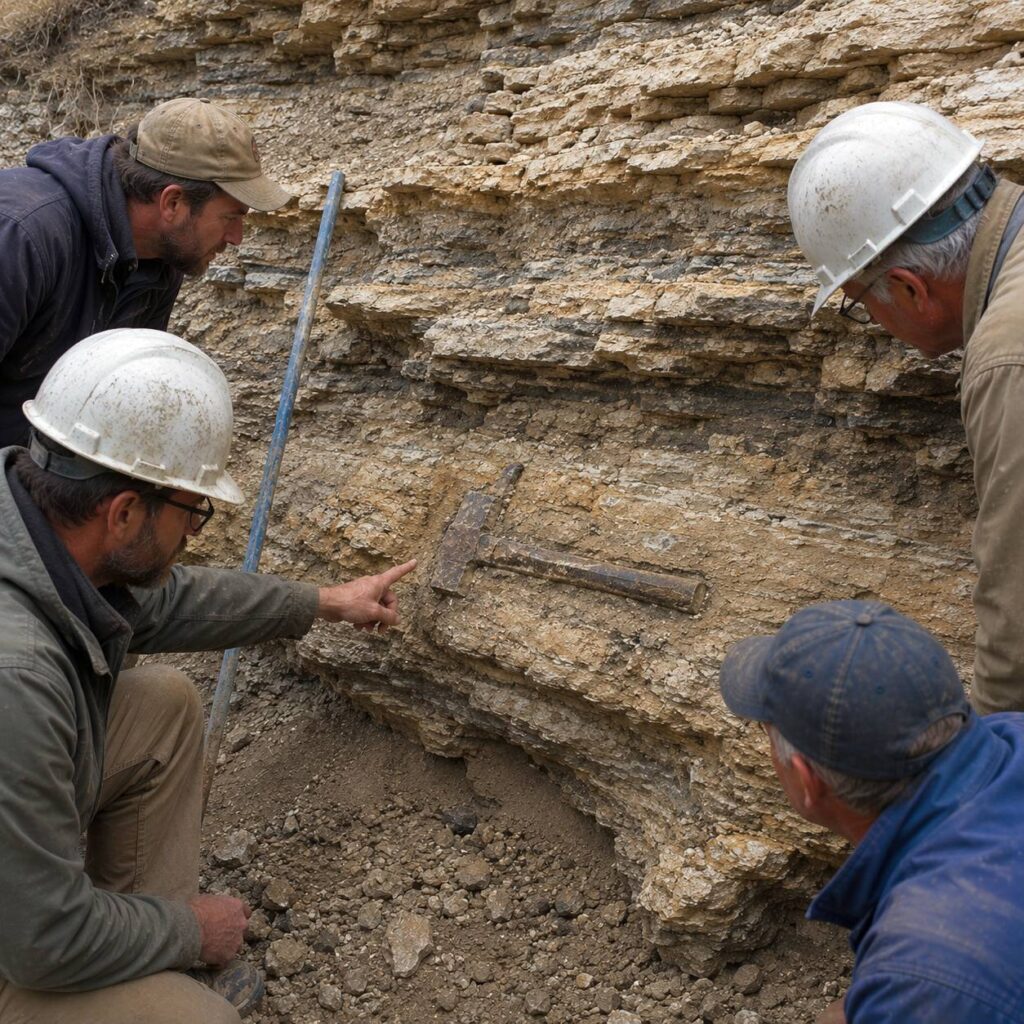
A hammer embedded in 100-million-year-old rock. The hammer was reportedly found near London, Texas, encased in a limestone-like concretion. This hammer appears to be a relatively recent tool, probably from the 19th century. The surrounding stone is a concretion that formed around the hammer after it was lost. The rock enclosing an object is not necessarily the same age as the surrounding geological formation. Concretions can develop around modern objects and become extremely hard. People assume that because nearby rocks are Cretaceous in age (~100 million years old), the hammer must be as old as those rocks.
3. The “Coal Age” Gold Chain (Illinois)
A newspaper article on a gold chain found in coal hundreds of millions of years old.
On June 11, 1891, The Morrisonville Times reported that Mrs. S. W. Culp of Morrisonville, Illinois, had discovered a gold chain embedded inside a lump of coal while preparing fuel for her stove. Later researchers believe she was Nina Maxon Culp, the wife of Silas W. Culp, but beyond that, little is known about her. No photographs of Mrs. Culp or the chain are known to exist, and the artifact itself disappeared long ago.
No artifact survives for scientific examination. The account comes from a single newspaper report. There was no controlled excavation or geological documentation. There is no way to verify the claim. Historians generally regard it as anecdotal rather than evidence.
4. The Coal Shoe Print
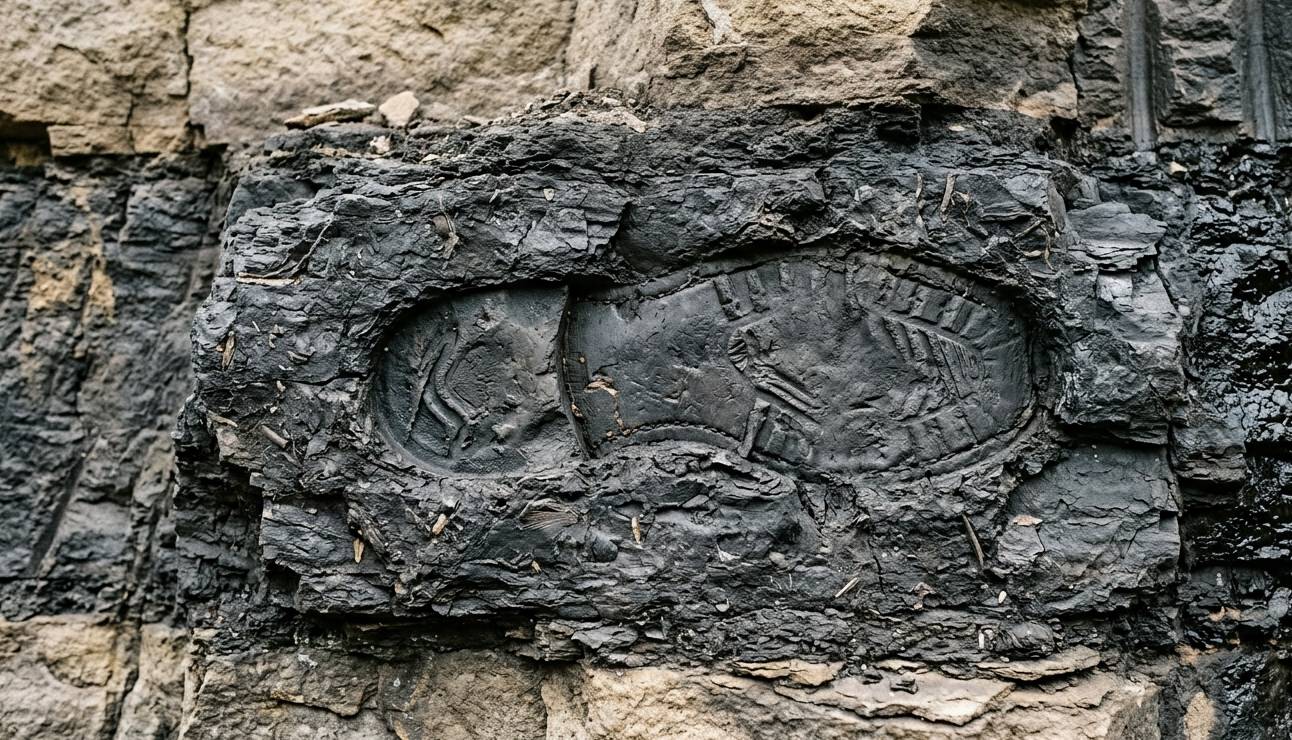
A human shoe print found in coal millions of years old. Various versions of the story have circulated since the early 20th century. The original specimens are poorly documented or missing. Many alleged footprints in coal are natural fracture patterns, ironstone markings, or erosional features. Extraordinary claims require preserved specimens and documented provenance, which are lacking.
One of the most famous cases emerged in 1922 when a mining engineer named John T. Reid brought attention to what appeared to be part of a human shoe sole embedded in ancient rock from Nevada. According to newspaper reports of the day, the object displayed a shape remarkably similar to a modern shoe, complete with what some observers interpreted as stitching marks around its edge. If genuine, the discovery would have challenged the entire accepted timeline of human history.
The story quickly attracted widespread attention. Newspapers and magazines described the find as a possible relic from a forgotten civilization that lived millions of years ago. Reid reportedly showed the specimen to scientists at major institutions, including Columbia University and the American Museum of Natural History. While the object generated considerable curiosity, experts were not convinced that it represented an actual shoe. Some concluded that the specimen was an unusual natural formation whose appearance merely resembled human workmanship.
As the years passed, the mystery deepened for an unexpected reason: the original specimen largely disappeared from public view. Without a preserved artifact available for modern analysis, researchers could not subject it to the rigorous testing that would be expected today. The lack of documented provenance, photographs from the time of discovery, and detailed scientific examination left the case resting largely on newspaper accounts and secondhand descriptions.
5. The Iron Pot from Coal (Oklahoma, 1912)
An iron pot discovered inside coal dating hundreds of millions of years. A newspaper account described a woman breaking coal and finding a metal vessel. Problems: No surviving artifact. No independent verification. No geological chain of custody. Like many coal-artifact stories, it remains an unverified anecdote.
6. The Salzburg Cube (Austria)
The Wolfsegg Iron. An artificial metal object allegedly from millions of years ago. An iron object was found in the late 19th century in a coal mine.The object was examined by several researchers. Most analyses concluded it was likely a piece of mining machinery, such as a cast-iron component. Its roughly geometric shape led some people to speculate that it was manufactured by an unknown ancient civilization. A modern industrial origin is considered far more likely.
7. Alleged Ancient Nails in Rock
Nails embedded in rock layers millions of years old have been reported repeatedly since the 1800s. What usually happened: Iron objects became enclosed within mineral deposits. Rusting created mineral casts that looked ancient. Reports were often secondhand and poorly documented. A common mistake: Confusing the age of the surrounding geological formation with the age of a mineral deposit that formed later.
Analysis
Most cases fall into one of four categories: Concretions -Minerals precipitate around an object and create a hard stone-like shell. Examples: London Hammer. Coso Artifact. A modern object can become enclosed without being millions of years old. Misidentified Natural Features-Natural fractures, fossils, and mineral patterns can resemble tools, footprints, or manufactured objects. Mining Contamination-Objects from mining operations can end up in coal seams, spoil piles, or excavated material, and later be mistaken for ancient finds. Poorly Documented Anecdotes-Many famous cases come from newspapers, letters, or retellings rather than controlled scientific investigations.

Are There Any Widely Accepted Cases?
No. If a genuine human-made artifact were conclusively shown to be embedded in undisturbed rock hundreds of millions of years old, it would be one of the most important discoveries in scientific history. It would force major revisions of archaeology, geology, paleontology, and human evolution. The reason scientists reject these famous cases is not because they challenge established ideas, but because they fail basic evidentiary standards: No secure provenance. No controlled excavation. No reproducible analysis. Often the object itself is missing. More ordinary explanations fit the evidence better. In short, the “artifacts in ancient coal and rock” stories are real as historical reports, but the evidence almost always points to modern objects, geological processes such as concretions, misidentifications, or unverified anecdotes rather than genuine artifacts millions of years older than humanity. Stories about “bells found inside rocks” are among the most frequently cited out-of-place artifact (OOPArt) claims, but when you trace them back to their original sources, the evidence is usually much weaker than later retellings suggest.
The Most Famous Case: The Dorchester Bell-Shaped Vessel (Massachusetts, 1852)
In May 1852, workers blasting rock on Meeting House Hill in Dorchester, Massachusetts, reportedly discovered a strange metal vessel among the debris. The story was first published in the Boston Evening Transcript and later reprinted in Scientific American on June 5, 1852.
The object was described as a bell-shaped vessel about 4½ inches high and 6½ inches wide at the base. It reportedly had flower designs inlaid with silver and was made of a zinc-colored metal. The find attracted attention because workers claimed it came from rock blasted from about 15 feet below the surface.
Over the years, some writers suggested the vessel was evidence of an ancient civilization because the local Roxbury puddingstone is geologically very old. However, no geologist documented the object embedded in undisturbed rock before the blast. The artifact itself has since disappeared and is not known to exist in any museum collection.
Modern archaeologists have proposed more ordinary explanations. Dr. Dave Landon of UMass Boston suggested it may have been a 19th-century candlestick, while Boston City Archaeologist Joe Bagley noted that it resembles the bowl of an Indian hookah. Without the original artifact or scientific documentation of its discovery, the Dorchester vessel remains an intriguing mystery rather than verified evidence of an ancient lost civilization.
The “Bell Found in Coal” Stories
Various books and magazines have repeated claims that small brass or bronze bells were discovered inside coal seams. Typical features of these stories: They usually originate from newspaper reports or secondhand accounts. The artifact is often unavailable for modern study. No photographs, excavation records, or chain of custody survive. The exact mine location is frequently unclear. Without the object itself and geological documentation, such reports cannot be verified.
The Mysterious Bell of Arizona
Another story sometimes circulated involves a bell supposedly found in association with ancient rock formations in Arizona and said to resemble Spanish or Asian craftsmanship.The problem: Multiple versions of the story exist. Details change depending on the source. There is no widely accepted scientific publication documenting the discovery. As with many OOPArt stories, later retellings often add dramatic details that are absent from the earliest accounts.
Why Bells Are Particularly Vulnerable to Misinterpretation
Bells are hollow metal objects. If lost in: caves, fissures, sinkholes, mine workings, sediment-filled cracks, they can later appear to be “inside rock.”Over time, mineral deposition can cement sediments around an object and create a stone-like matrix. People encountering such an object later may assume the surrounding material is as old as the host rock formation. Imagine a bell is dropped into a crack in a cliff 500 years ago. Over centuries: sediment fills the crack, minerals precipitate, the fill hardens into a rock-like mass. A future discoverer breaks open the cliff and sees a bell enclosed in stone. The bell is genuinely inside stone—but not because it is millions of years old. The stone around it formed much later than the original cliff. This distinction is central to most OOPArt investigations.
What Would Convince Scientists?
A truly revolutionary bell discovery would require: Discovery during a controlled excavation. Detailed geological mapping. Photographs of the object in situ (in its original position). Independent examination by multiple experts. Reliable dating of both the object and surrounding material. Elimination of fractures, cavities, and later intrusions. No famous “bell in rock” case meets those standards.
Why the Stories Persist
The bell stories are compelling because bells are unmistakably manufactured objects. Unlike a footprint-shaped mark or oddly shaped stone, a bell is clearly artificial. If one were genuinely sealed inside rock that formed hundreds of millions of years ago, it would be extraordinary evidence. The problem is that the famous cases rely almost entirely on old reports, anecdotal accounts, and assumptions about the age of the surrounding rock rather than direct evidence that the bell itself was trapped there when the rock originally formed. As a result, historians of science generally regard the bell stories as intriguing historical anecdotes rather than established evidence of ancient advanced civilizations or humans living millions of years ago.