The Ghost of Princess Diana
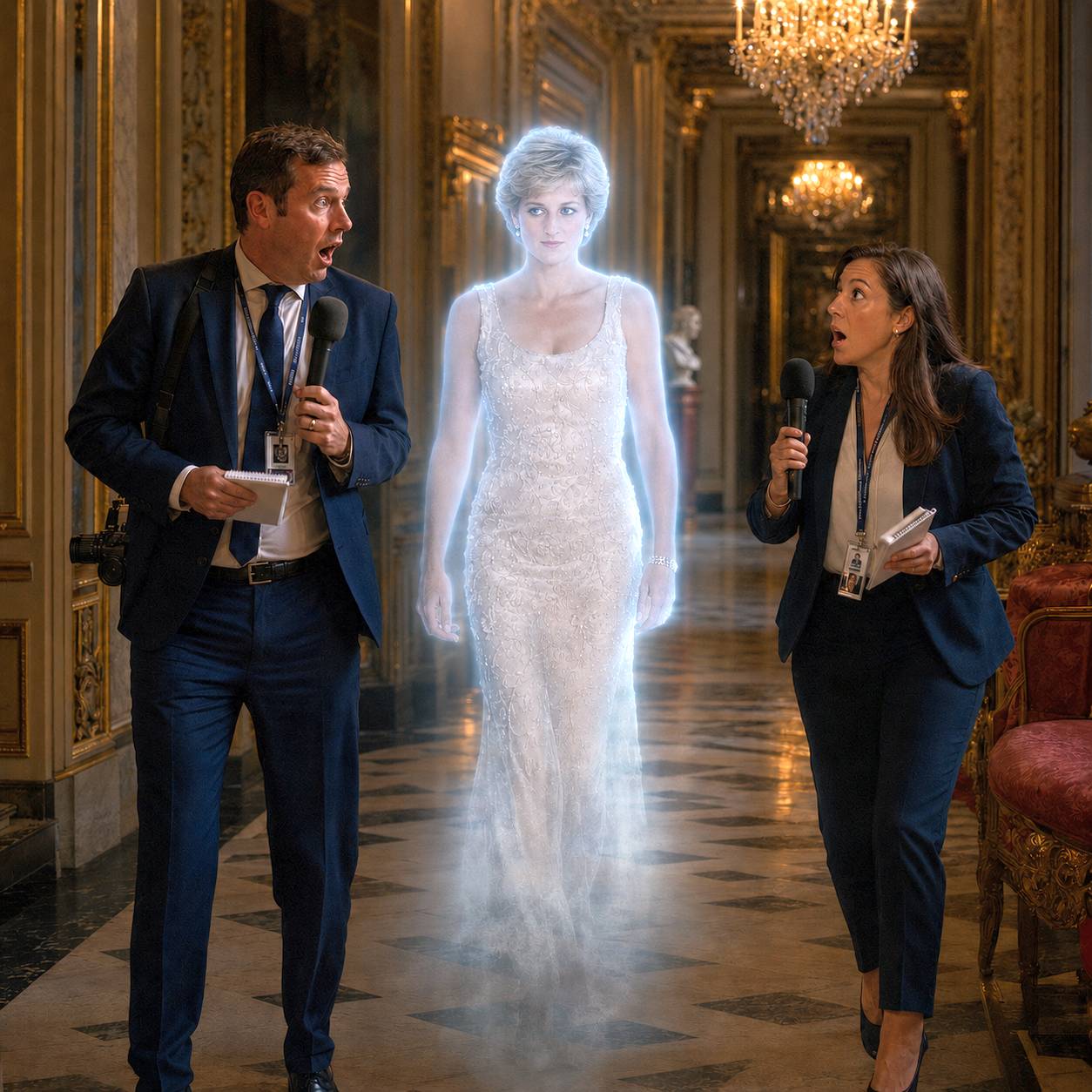
She was 36 years old when the world lost her — August 31, 1997, in a Paris underpass. Princess Diana’s death was so sudden, so seismic, that it left a wound in the public consciousness that has never fully closed. She was laid to rest on a small, private island within the ornamental lake at Althorp, her family’s ancestral Northamptonshire estate. Almost immediately, the stories began: people swearing they had felt her. Seen her. Sensed her, standing just at the edge of sight.
There is no scientific evidence that Diana’s spirit walks anywhere. But belief doesn’t need proof to spread — and few figures of the 20th century have inspired as much devoted, aching folklore as the woman the press dubbed the “People’s Princess.”
The wedding balcony, April 29, 2011. The most widely circulated modern account centers on the moment Prince William and Catherine Middleton appeared on the Buckingham Palace balcony after their Westminster Abbey wedding, sharing two kisses for the cheering crowd below. When footage of the broadcast recirculated years later, viewers began claiming that a figure resembling Diana could be glimpsed just behind William, and that her voice was audible under the noise of the crowd. On HubPages, one widely shared writeup of the clip quoted commenters insisting “I see it” and “wouldn’t surprise me,” while the author of the piece admitted candidly that she couldn’t make out the figure herself.
Even the mainstream press leaned into the symbolism without claiming the supernatural: ABC News’ same-day wedding coverage was headlined “Spirit of Princess Diana Echoes Through Westminster Abbey,” noting William’s nervous lip-chew — a mannerism identical to his mother’s — and the fact that he and Kate had visited Diana’s grave at Althorp just days before the ceremony. That’s the pattern with nearly every “sighting” of Diana: real, observable echoes of her — a gesture, a dress detail, a public gap where she should have stood — reinterpreted by grieving fans as an actual visitation.
The actresses who played her. Two women who portrayed Diana on screen have described experiences they read as more than coincidence. Kristen Stewart, who played Diana in the 2021 film Spencer, has spoken publicly about feeling an unusual, almost spiritual charge while filming, which she interpreted as a kind of “sign-off” from the woman she was portraying. Naomi Watts, who starred in the 2013 biopic Diana, has likewise described sensing Diana’s presence during production and wondering whether she’d been granted permission to tell her story. Neither actress has claimed a ghost sighting in the traditional sense — these are subjective, performance-related experiences, but they’re frequently folded into the broader Diana-ghost mythology by fans and tabloids alike.
Mediums and psychics. Several self-described psychics have claimed ongoing contact with Diana since 1997, including practitioners who say they worked with her while she was alive and continued “receiving” messages from her afterward. These claims have generated substantial tabloid coverage over the decades but no evidence that would meet any independent standard of verification — they remain, structurally, unfalsifiable.
Althorp itself — strangely quiet. You’d expect Diana’s childhood home and final resting place to be the epicenter of her legend. It isn’t. Althorp’s actual, longstanding ghost lore predates her by centuries: a spectral groom said to wander the grounds carrying a candle, and a ghostly girl in gray slippers reportedly seen in the house. Diana’s brother, Charles Spencer, who has owned and lived at Althorp since their father’s death in 1992, has said on record that he has never personally encountered a ghost there — hers or anyone else’s. That’s a notable, and rarely reported, wrinkle in the mythology: the place most associated with Diana in death has no real folklore attached to her at all.
Why the stories persist. Grief researchers describe something called a “sense of presence” — a documented psychological phenomenon in which a person feels someone is near even when no one is physically there, common among the bereaved and not indicative of anything supernatural. Diana’s death produced this at a civilizational scale: millions of people who had never met her felt, genuinely, that they had lost someone close. That’s fertile ground for ghost stories that are, almost without exception, warm rather than frightening — comfort, not horror.
The Ghost of Queen Elizabeth II
She reigned for seventy years. When Queen Elizabeth II died at Balmoral Castle on September 8, 2022, it wasn’t just the end of a life — it was the end of an era so long that most of the living world had never known another monarch. Within two years, sightings were being reported at the two houses most bound up with who she actually was: Windsor Castle and Balmoral.
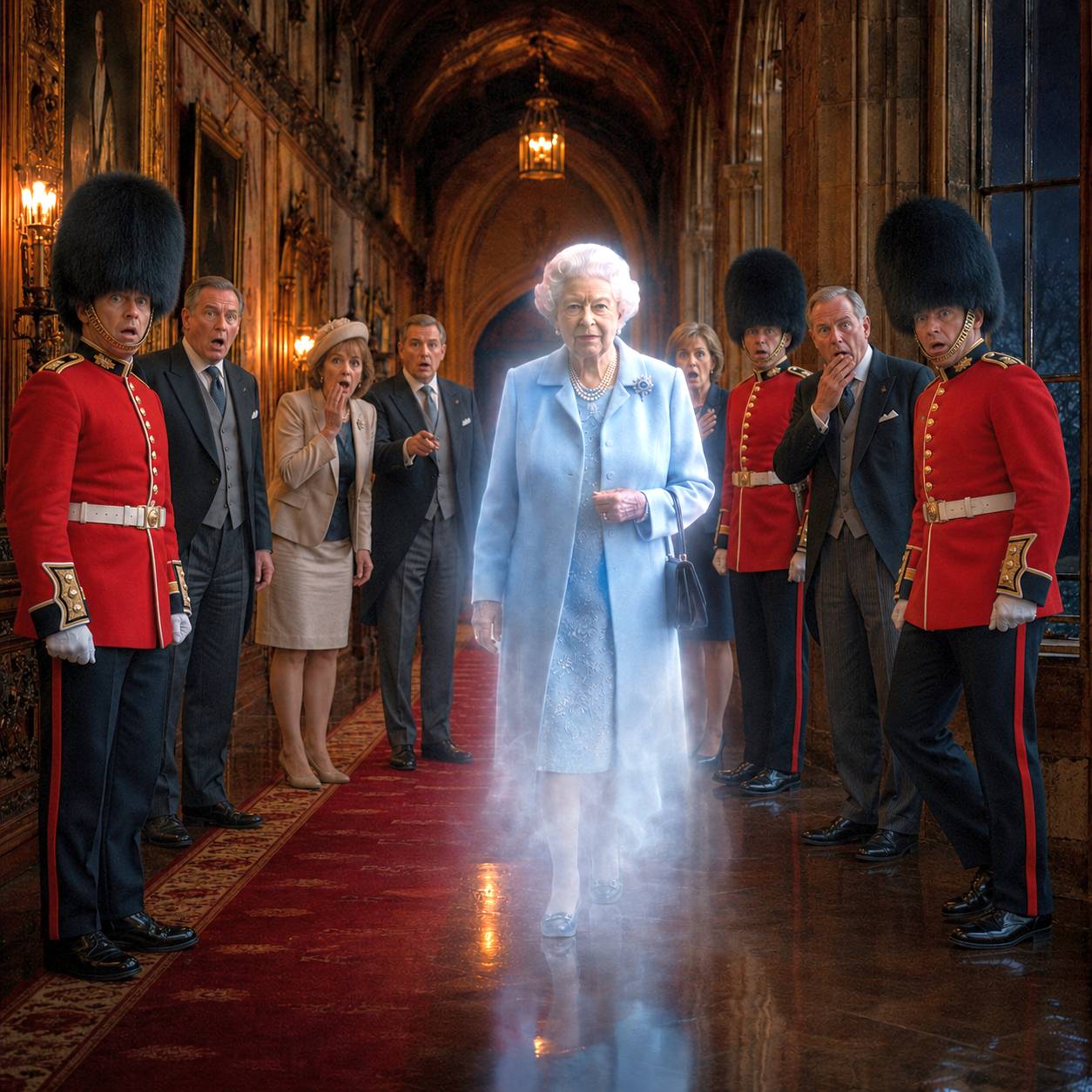
The Windsor Castle photographs, July 2024. The most concrete and widely reported claim came from the tabloid outlet RadarOnline, which published two photographs it said were supplied by an anonymous amateur photographer during a public tour of Windsor Castle. The photographer described noticing a white “flash” in a viewfinder that, on review, appeared to resemble a woman in a coat and hat, carrying what looked like one of the Queen’s signature Launer “Twisted Rope” handbags.
The source — who asked not to be named, citing fear of ridicule — was quoted describing the figure as looking “worried,” and speculated the Queen’s spirit might be troubled by the family’s recent difficulties, including King Charles III’s and Catherine, Princess of Wales’s cancer diagnoses that year.
The story was picked up and recirculated by outlets including SheKnows and the Royal Observer through the summer of 2024. No independent photographic analysis has ever verified the image as anything other than a lighting artifact or misidentified figure.
Elizabeth I in the library — a claim about the Queen, not of her. In the 2024 Amazon Prime documentary The King of UFOs, paranormal historian Richard Felix made a striking claim: that Elizabeth II herself once encountered the ghost of her Tudor namesake, Elizabeth I, in the library at Windsor Castle — and that King Charles III has seen the same figure, and that King George VI reportedly saw it eight separate times before the outbreak of World War II. Felix told the documentary that the royal family is aware their properties are haunted and has “witnessed it” directly.
This isn’t a sighting of Elizabeth II’s own ghost, but it reinforces the idea that Windsor’s library specifically functions as a kind of hinge point in royal ghost lore. The claim has real historical scaffolding behind it: author Richard Jones, in Haunted Castles of Britain and Ireland, documented an 1897 account from Lieutenant Carr Glynn of the Grenadier Guards, who reported watching a woman in black — resembling portraits of Elizabeth I — walk past him in the library and vanish around a corner. Royals commentator Hilary Fordwich has separately told Fox News Digital that both Elizabeth II and her sister, Princess Margaret, reported witnessing the same apparition in that same room.
A wider haunted map. Felix’s documentary claims extend well beyond Windsor: he has also stated that Anmer Hall, the Norfolk home of the Prince and Princess of Wales, is haunted by the ghost of a Catholic priest executed for treason centuries ago, a claim William reportedly laughed off when he first heard it. Windsor’s broader ghost roster, according to royal historians and multiple outlets, includes Henry VIII, George III, and a Grenadier Guardsman said to have died by suicide on the grounds.
Glamis Castle, the childhood home of the Queen Mother, carries its own dense catalogue of legend, including the “Gray Lady” (Janet Douglas, executed for witchcraft in 1537) and a figure locals call the “Monster of Glamis.” The Queen Mother herself was said to have reported hearing Janet Douglas’s footsteps in the castle’s library.
A family with a documented interest in the paranormal. This isn’t invented context — the House of Windsor’s relationship with spiritualism has a real historical record. Queen Victoria became seriously involved in spiritualist practice following Prince Albert’s death in 1861, reportedly holding séances at Windsor with the help of her servant John Brown.
It has also been reported, though not confirmed by the Palace, that Elizabeth II took part in a séance attempting to reach her late father, George VI. Diana, Prince Harry, and Elizabeth II have all been reported, at various points, to have consulted mediums or spirit guides — claims covered by outlets including People magazine and TripSavvy in connection with Felix’s documentary.
The throughline. As with Diana, none of the Elizabeth II material holds up to independent scrutiny — a tabloid photograph, an anonymous source, a documentary claim from a paranormal historian rather than a royal household statement. What’s verifiable is the emotional logic: a monarch who spent seventy years in visible, constant service, reportedly still walking the halls she loved, in a family with a genuine, generations-deep fascination with the idea that the dead don’t entirely leave.