Few American ghost stories are as unusual as the Greenbrier Ghost case of West Virginia. It combines a suspected murder, a grieving mother who claimed to receive visits from her dead daughter, a disturbing exhumation, and a criminal conviction. The case has become famous as the story of a ghost who supposedly revealed the identity of her own murderer. But the historical record also shows that the conviction rested on substantial physical and circumstantial evidence—not simply on a supernatural apparition.
The death of Zona Heaster Shue
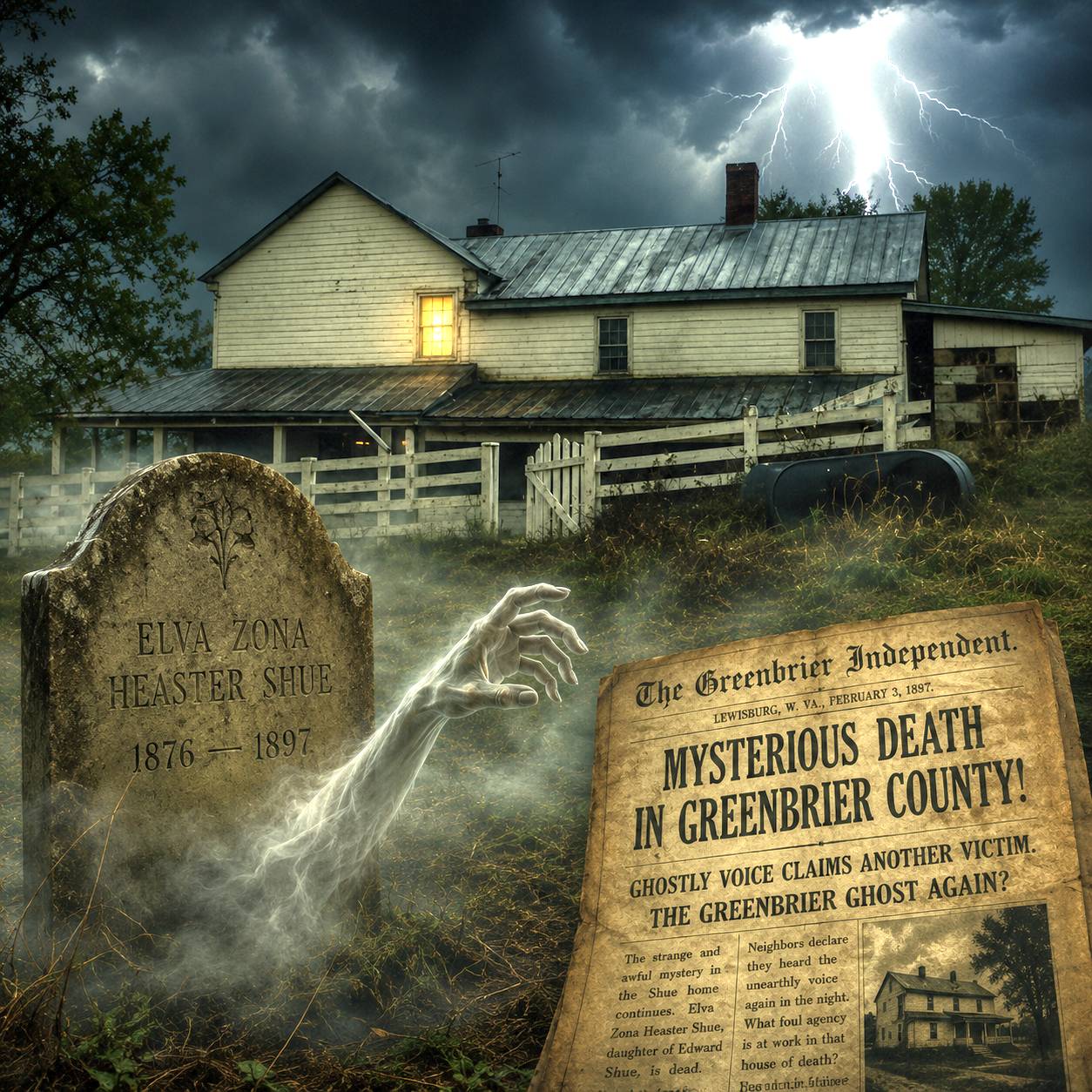
In October 1896, Elva Zona Heaster, usually called Zona, married a blacksmith named Erasmus Stribbling Trout Shue, who was also known by other names, including Edward Shue. The marriage lasted only a few months. On January 23, 1897, Zona was found dead in the couple’s home in Greenbrier County, West Virginia. A local boy had been sent to the house and discovered her body. Her husband had reportedly moved her to a bed and dressed her in a high-necked garment before the examining doctor arrived. The circumstances surrounding the handling of the body later became an important part of the case. At first, Zona’s death was not treated as murder. The initial explanation was essentially that she had died from natural causes, although the precise early descriptions of the cause of death varied in contemporary accounts. Zona was buried the following day. A coroner’s jury gave a verdict of “death by heart disease” even though the medical examination was not fully conducted.
The ghost allegedly appears
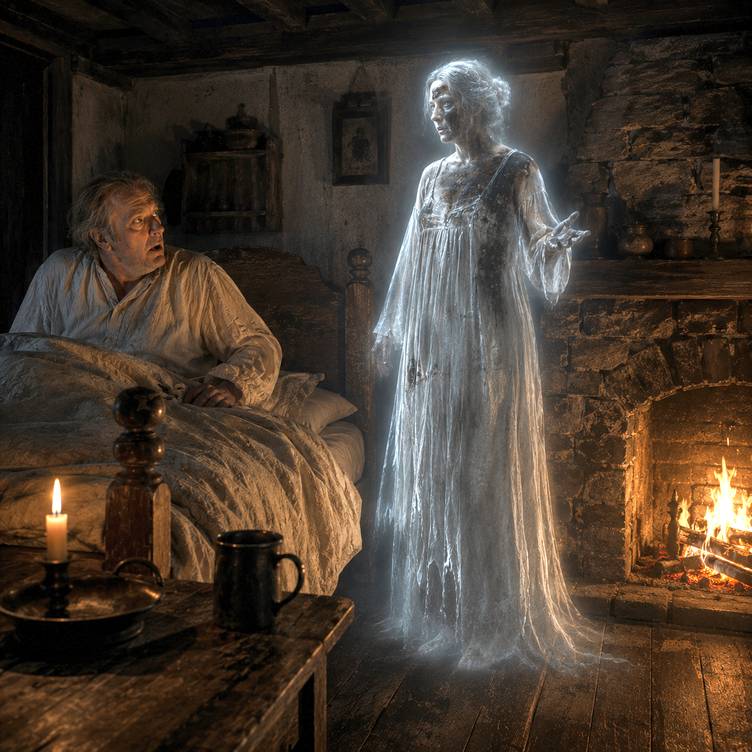
Zona’s mother, Mary Jane Heaster, never trusted her daughter’s husband. According to her later testimony, several weeks after Zona’s burial, her daughter’s ghost began appearing to her. Mary Jane claimed that the apparition appeared repeatedly and told her that Zona had been murdered. The ghost allegedly said that Trout Shue had attacked her during an argument and had broken her neck. The apparition supposedly demonstrated the injury by turning its head unnaturally far to one side. Mary Jane eventually went to John Alfred Preston, the local prosecutor, and told him what she claimed her daughter’s spirit had revealed. This is the point at which the story enters the realm of the supernatural. However, Preston apparently did not simply order an exhumation because he believed a ghost had spoken to Mary Jane. Other circumstances surrounding Zona’s death had already created questions, and the prosecutor investigated further. He was skeptical enough to dispatch deputies to reinterview several people of interest in the case, including the examining doctor of Zona, Doctor Knapp. The Prosecutor was agreeing to public sentiment to do further investigation, as numerous local people had began suggesting that Zona was murdered. Furthermore, the original medical examination had not been complete, providing a reason to reexamine the body and the formation of an inquest jury.
The shocking exhumation
Zona’s body was exhumed on February 22, 1897, approximately a month after her burial. The examination revealed severe injuries to her neck. According to accounts of the autopsy, her neck had been dislocated between the upper vertebrae, her windpipe had been crushed, and there were indications consistent with strangulation. The findings transformed the case. Zona had not simply died of natural causes. The evidence indicated that she had been violently killed. Trout Shue was arrested and charged with murder.
The trial
The trial became one of the most sensational criminal proceedings in West Virginia. Mary Jane Heaster was a major witness for the prosecution. The prosecutor, however, reportedly concentrated on the earthly evidence and did not make the ghost the centerpiece of the case. The defense attorney questioned Mary Jane extensively about her alleged supernatural encounters with Zona. Ironically, this may have made the ghost story even more prominent in the courtroom. Mary Jane did not retreat from her story. She maintained that her daughter had appeared to her and had revealed how she had died. The prosecution also presented evidence concerning the condition of Zona’s body and the circumstances surrounding her death. The physical evidence showed that Zona had suffered fatal injuries to her neck. On March 9, 1897, the published autopsy revealed that ” the discovery was made that the neck was broken and the windpipe mashed. On the throat were the marks of fingers indicating that she had been choked. The neck was dislocated between the first and second vertebrae. The ligaments were torn and ruptured. The windpipe had been crushed at a point in front of the neck.” Also, during the trial, it was revealed while Trout (Charles) Shue was incarcerated in a jail in Lewisburg, West Virginia waiting for the trial to begin, Trout Shue told inmates he was married twice before and his first marriage had ended in divorce with his wife accusing him of great cruelty, and his second wife died under mysterious circumstances a year before his marriage to her. Zona was his third wife. On July 11, 1897, Trout Shue was convicted of first-degree murder and sentenced to life imprisonment. He was later imprisoned at the West Virginia Penitentiary in Moundsville, where he died in 1900.
Did a ghost actually help convict a murderer?
This is where the famous legend needs some qualification. The popular version of the story says: Zona’s ghost told her mother who killed her, the body was exhumed, the autopsy confirmed the ghost’s story, and the murderer was convicted. The historical reality is more complicated. The autopsy did confirm that Zona had been violently killed, but the ghost’s alleged account was not, by itself, the legal proof of the murder. The conviction was based on the physical evidence and the circumstances surrounding Shue’s behavior and Zona’s death. The ghost story was part of the public and courtroom drama, but the prosecution did not simply convict Shue because a ghost had supposedly testified.
Possible explanations
Believers in the paranormal see the case as extraordinary evidence that Zona’s spirit returned to expose her killer. The alleged correspondence between the mother’s story and the autopsy findings remains the most mysterious aspect of the case. Skeptics offer several possibilities: Mary Jane may have already suspected that Shue had murdered her daughter. She may have inferred the cause of death from clues surrounding Zona’s body. The ghost story may have been a way to persuade authorities to reopen a case that otherwise might have been ignored. Details may have become more dramatic as the story was repeated in newspapers and later retellings. Some historians and writers have suggested that Mary Jane may have used the ghost story deliberately because she feared Shue and believed the authorities would take a supernatural revelation more seriously than an unsupported accusation from a grieving mother.
The famous historical marker
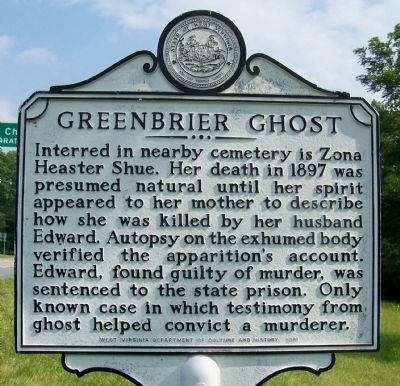
A historical marker near the cemetery where Zona’s grave is has helped preserve the legend. The case is often described as the only known American murder case in which testimony about a ghost helped secure a conviction. That wording is one reason the Greenbrier Ghost has become so famous. Strictly speaking, however, the ghost was not a conventional legal witness whose supernatural testimony alone established guilt. The case is better understood as a murder investigation in which a mother’s extraordinary claim about a ghost helped draw attention to a suspicious death that was subsequently proven to be a homicide through physical evidence.
Why the Greenbrier Ghost remains famous
The case continues to fascinate people because it sits directly on the boundary between true crime, folklore, and the paranormal. There is a documented murder. There was a real exhumation. There was real physical evidence of a broken neck and fatal injuries. There was a real murder conviction. The mystery is whether Mary Jane Heaster truly saw her daughter’s spirit—or whether the ghost story was a mother’s desperate, ingenious, or possibly subconscious way of bringing attention to what she already believed had happened. The Greenbrier Ghost remains one of America’s most famous alleged cases of a dead victim supposedly returning from beyond the grave to help expose her own murderer.