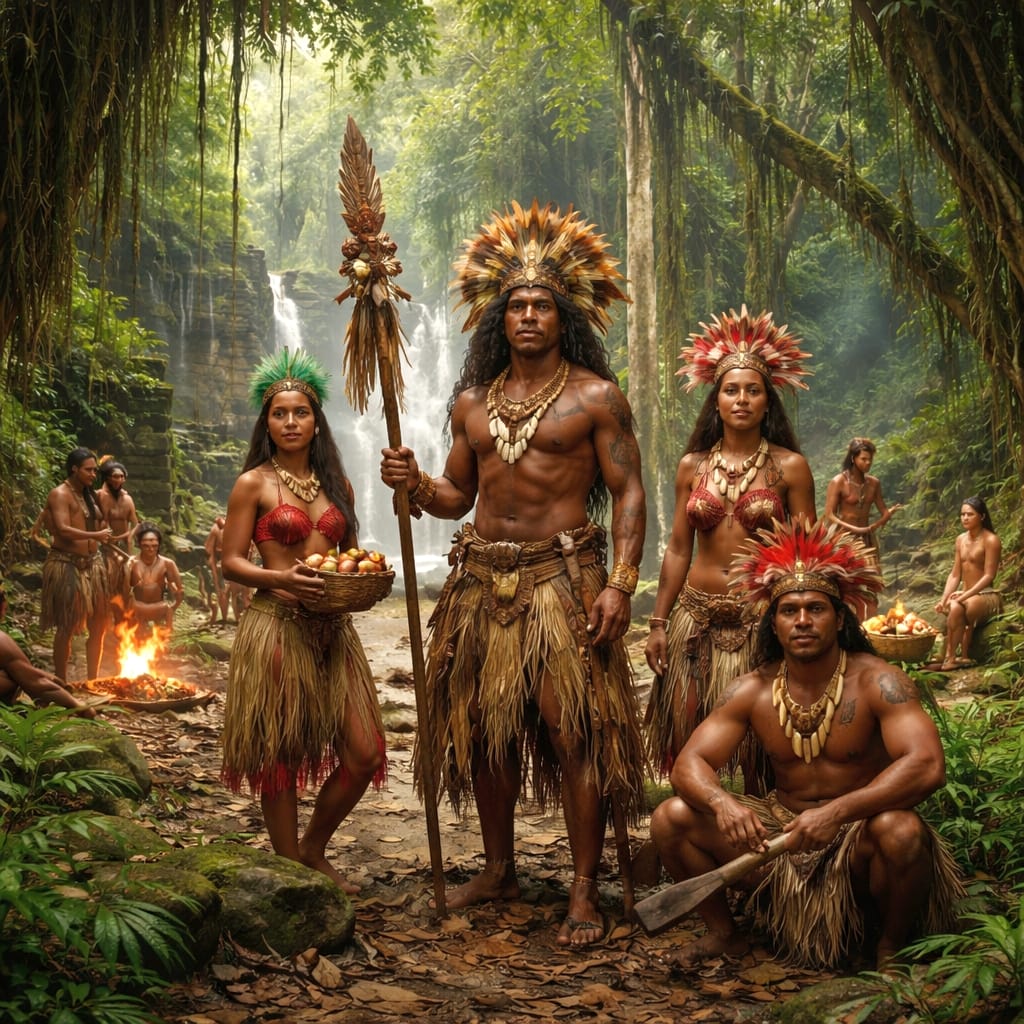
The Polynesians are the indigenous people from Polynesia, which is basically the triangular shaped territory of Hawaii, New Zealand, and Easter Island, although there are some island outside that area. The most prominent Polynesian languages, according to the number of speakers, are Samonan, Tongan, Tahitian, Maori, and Hawaiian, There is credible evidence that Polynesians had contact with South America before Columbus, and this makes it one of the strongest cases of pre-Columbian transoceanic contact accepted by mainstream scholars. And it shows ancient peoples were far more capable sailors than what was once believed. The Pacific was not an absolute barrier, but a navigable world long before European exploration. Here is how we know, and what is still debated, but accept by the vast majority of research scientists:
The Sweet Potato: the Clearest Evidence
The sweet potato (Ipomoea batatas) is native to South America, yet it was widespread across Polynesia centuries before Europeans arrived. Archaeological dates show sweet potatoes in Polynesia by ~1000–1200 CE. Polynesians called it kumara / kūmara. Similar words existed among Indigenous South American peoples (e.g., Quechua kumar, also spelled as ‘cumal’ or ‘cumar’}. This is extremely difficult to explain without human contact, because: Sweet potatoes do not naturally float across oceans and remain viable. They require intentional cultivation. Most scholars agree this indicates direct or indirect human transfer. Genetic studies show Polynesian varieties derive from South American lineages.
Polynesians could actually make the journey
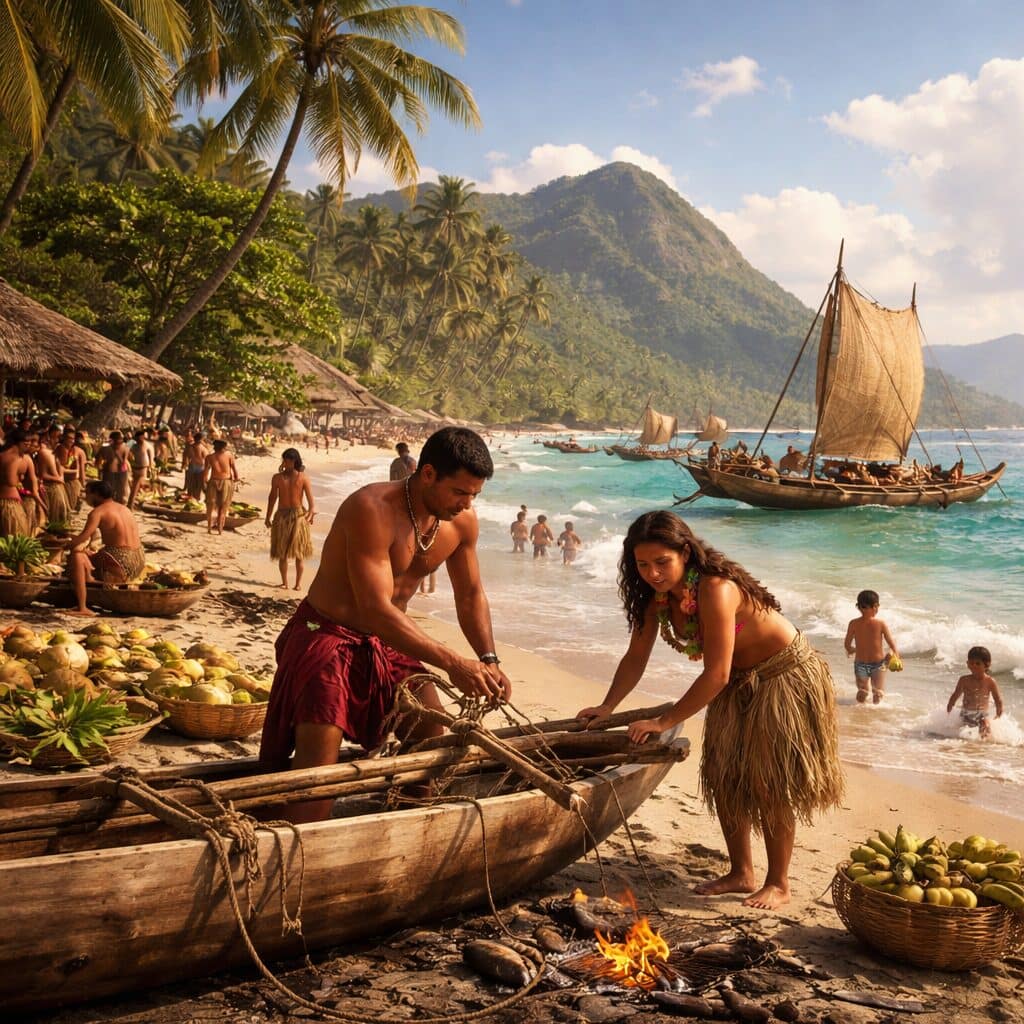
Unlike many ancient cultures, Polynesians were elite open-ocean navigators. They used: Large double-hulled canoes. Knowledge of stars, swells, winds, birds, and clouds. Purposeful long-distance exploration (Hawaiʻi, Rapa Nui, New Zealand). Computer simulations and experimental voyages show that: Voyages from Polynesia to South America and back are feasible. Prevailing winds and currents make return trips possible, not just one-way drifts. Also, consider the case of Thor Heyerdahl, a famous Norweign anthropologist, archeologist, adventurer, traveler, and writer. He claimed that people could have journeyed from South America to Polynesia in ancient times. To prove his assertion, he had built a traditional bassa wood raft, being 45 feet long, that was constructed by hand, which he christen as “The Kon-Tiki” named after the Incan sun god “Viracocha” for whom “Kon-Tiki” was said to be an old name. On April 28, 1947, Thor Heyerdahl and five other crew members set sail from Callao, Peru and, after 97 days, drifted 8,000 kilometers: 5,000 miles across the Pacific Ocean to the Tuamotu Islands which are a French Polynesian chain of just under eighty islands and atolls in the southern Pacific Ocean. The success of The Kon-Tiki voyage proved that ancient peoples could have traveled thousands of miles by the oceans to have contacts with other ancient peoples on various lands through their then existing technology and materials then available. In 1948, Thor Heyerdahl wrote a book of his famous, fantastic voyage, entitled “The Kon-Tiki Expedition: By Raft Across the South Seas”.
Genetic Ethnic Evidence
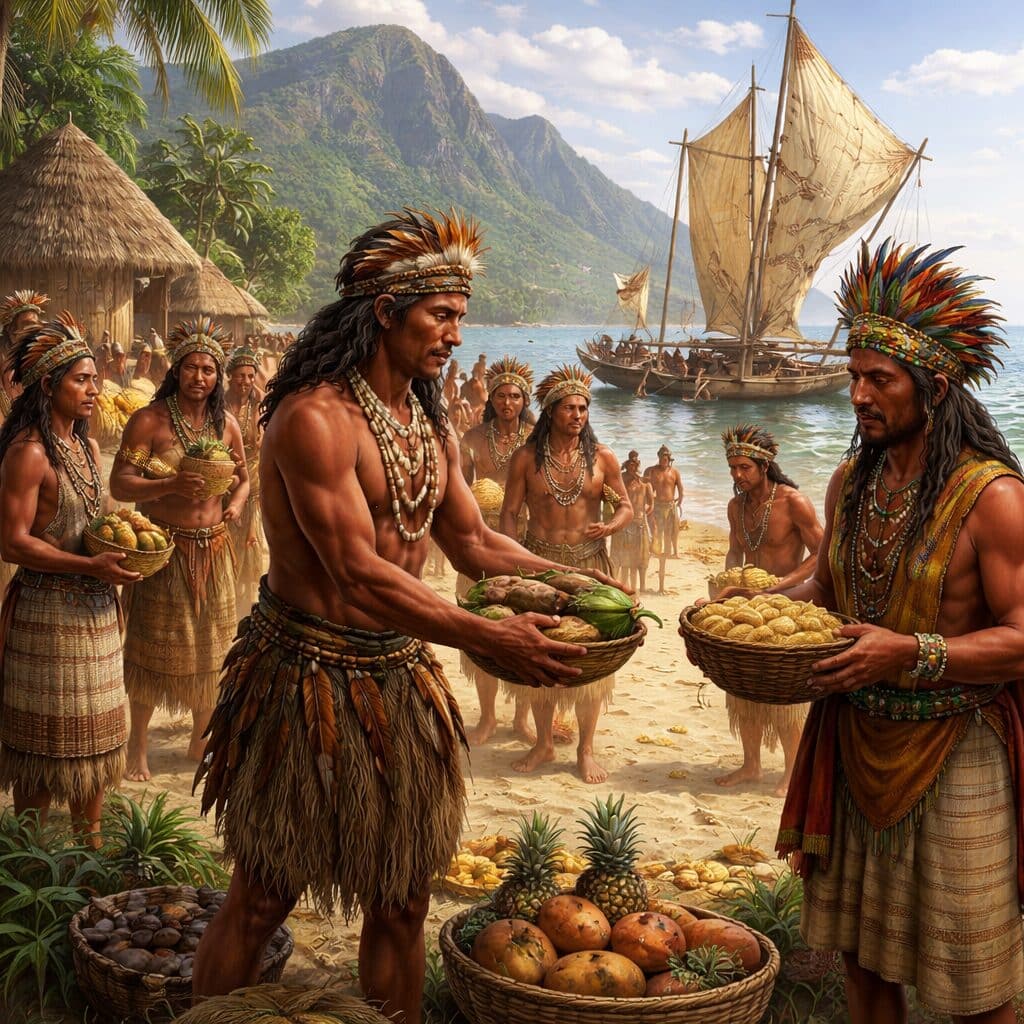
Recent DNA studies show: Some Indigenous peoples of Colombia and coastal South America have small Polynesian genetic signals: direct biology traces of contact. Contact likely occurred around 1200 CE. The genetic exchange was minor, suggesting limited contact, not colonization. This aligns well with the sweet potato timeline. In 2020, a major genomic study published in Nature analyzed DNA from Indigenous populations along the Pacific coast of South America (notably Colombia and Ecuador) and Polynesian islanders (including the Marquesas, Easter Island/Rapa Nui, and others). The researchers found: A distinct Polynesian genetic signal in some Indigenous South Americans. This signal could not be explained by post-European contact. Statistical modeling dated the admixture to around AD 1150–1300, centuries before Columbus. This timing matches the period of Polynesian long-distance expansion, when expert navigators were settling the farthest reaches of the Pacific. The data point to: Small-scale contact events. Likely involving a few individuals. Possibly through Polynesian voyaging to South America, or limited reciprocal movement or more likely even both voyaging of peoples. Thor Heyerdahl strongly believed there was migration of Polynesians to South America as well as Native South American Indians to Polynesia and vice versa centuries before Christopher Columbus. Oral traditions in Polynesia referencing voyages to distant eastern lands. Even minimal contact would leave a detectable genetic signature over the centuries.
Chicken Bones And Their DNA Evidence
Before European contact, chickens did not naturally exist in the Americas. They were domesticated in Southeast Asia thousands of years earlier and spread across the Pacific by Polynesian voyagers, who routinely carried animals and plants (chickens, pigs, dogs, taro) with them on long ocean voyages. So when chicken remains appear in pre-Columbian archaeological layers in South America, they demand an explanation.
The key discovery comes from El Arenal-1, an archaeological site on Chile’s Arauco Peninsula. Chicken bones were found in a layer securely dated to around AD 1300–1400. This date is before Spanish contact (which began in Chile in the 1530s) The bones were associated with indigenous Mapuche cultural materials, not European ones. Radiocarbon dating of the bones initially supported a pre-Columbian age.Early DNA analysis of the Chilean chicken bones showed: Mitochondrial DNA haplotypes closely matching Polynesian chickens. These haplotypes were distinct from European chicken lineages. This suggested that the chickens arrived via Polynesian seafarers, not Europeans. Later studies debated these results, but the Polynesian match remains plausible, especially when combined with the other lines of evidence. Polynesians commonly transported: Chickens (lightweight, easy to feed, fast-breeding). Root crops and other domesticated species. Transporting chickens to South America would have been practical and consistent with Polynesian expansion behavior. Chicken remains found in Chile were once thought to be Polynesian and pre-Columbian. Early studies supported this. Later research questioned contamination and dating.Some scholars argue that: Radiocarbon dates may be affected by contamination. DNA markers could overlap with early European chicken lineages. Current consensus: Chickens are possible but not conclusive evidence. The sweet potato remains far stronger.
Rapa Nui (Easter Island) as the Bridge
Rapa Nui lies far east in Polynesia, making it a likely contact point. Polynesians reached Rapa Nui by ~1200 CE. From there, South America is closer than from central Polynesia. Cultural exchange may have involved short stays or trade, not settlement. Rapa Nui shows especially strong evidence of pre-Columbian contact: Some individuals carry Native American genetic markers. These markers predate European arrival. The admixture likely occurred before or during initial settlement of the island. This suggests Polynesians did not just drift to South America, but that people moved in both directions, or that Polynesians reached South America and returned with individuals or descendants. Polynesians were among the most skilled navigators in human history: Oceanic way finding using stars, swells, winds, and birds. Regular voyages over thousands of kilometers. Settlement of remote islands like Hawaiʻi, New Zealand, and Rapa Nui. Reaching South America from eastern Polynesia would have been difficult but achievable, especially with favorable currents and winds.
What this contact was not:
Not a large scale migration. Not a colonization of South America by Polynesians. Not a long nor forgotten empire. It was likely: Small groups of skilled sailors. Brief encounters or exchanges. Limited but a real biological and cultural transfer. There was not a sustained contact between the Polynesians and Native Andean American Indians.
Closing
Millions and millions of peoples the world over do not even know about the Polynesians visiting and having various encounters with the Native South American Indian nations, centuries before the time of Christopher Columbus and his crews. This article not only educates the great masses of people about such historical contacts, but gives credit to the knowledge and skills of these Polynesian travelers. In various legends and folklore of the Native South American Indians, there are traces of information which speak about these brave, adventurous Polynesians. And, as for North America, the United States of America shares a special heritage with the ancient Polynesians because they lived in the state of Hawaii for thousands of years. Hawaii is the 50th state of the Union; the USA, and it became a state on August 21, 1959 under the administration of President Dwight D. Eisenhower. There is also the USA territory of American Samoa, that covers 7 south Pacific islands and atolls. The Samoans are just one group of people or many group of peoples that are Polynesians.