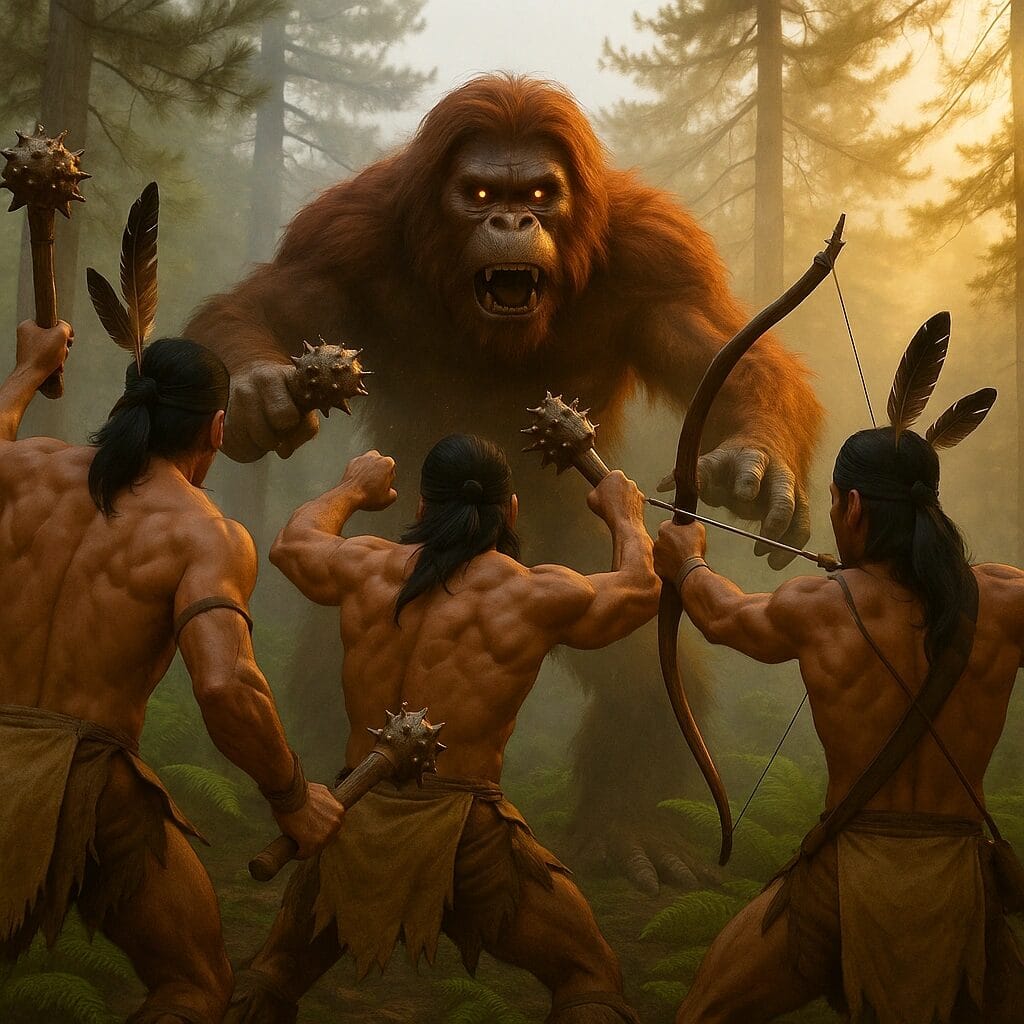
Today we examine the legendary Choctaw Bigfoot War said to have taken place in the mid-1800s in what is now Oklahoma, in the eastern part. This story appears in modern folklore rather than verified historical records.
In the rolling forests and rugged river valleys of what is now southeastern Oklahoma, the Choctaw Nation carried with them ancient stories of wild, hairy beings that roamed the wilderness. To the Choctaw, these creatures were known by several names, often translated as “Tall Man” or “Hairy Man of the Woods.” Long before European settlers arrived, these beings were feared and respected as something between animal and supernatural spirit. By the mid-19th century, the Choctaw Nation had been forced into Indian Territory after the Trail of Tears. They resettled and rebuilt their communities — but according to legend, something else already lived in the deep timber: a tribe of violent, man-like giants.
Dark Visitors in the Night
The legend describes the year 1855 as a time of increasing fear. Small hunting camps and isolated homes reported strange cries echoing through the trees. Horses were found dead, their bones broken as though by immense force. Most terrifying of all, children began to disappear. Tracks much larger than a man’s footprint surrounded the sites of abductions — impressions deep enough to suggest great weight and power.
The Choctaw leaders called these beings “Nahullo” — a term sometimes used for large foreigners, but in this context describing pale, hulking forest giants covered with coarse hair. Some versions of the story say these creatures were cannibalistic, emerging under the cover of night to steal people from their beds.
The Choctaw Warriors Take Action
Determined to protect their communities, the Choctaw chiefs supposedly organized a fighting party — a group of elite warriors known for their skill with bows, lances, and rifles. One legendary figure often named in the tale is Chief Oklahoma (sometimes conflated with other Choctaw leaders of the period). These warriors were said to be towering men themselves, chosen for their exceptional height and strength. They rode into the thickly forested mountains near the Red River in search of the Nahullo. Some warriors used specially trained hunting dogs bred for strength and aggression — animals capable of tracking and confronting dangerous predators.
A Battle in the Woods
The confrontation, as described in oral tradition, took place over several days. The Choctaw warriors tracked the creatures to caves and remote ravines. The Nahullo reportedly fought with sheer raw power — able to uproot trees, hurl boulders, and move faster than their size should allow. Stories describe brutal clashes: warriors dragged from horses, dogs thrown aside like twigs, and rifle shots echoing through the woods. In the end, the Choctaw fighting party is said to have eliminated the raiding group, rescuing the remaining missing children and restoring peace to the settlements. Victorious, the warriors returned home telling of monstrous bodies too large to easily bury and too frightening to leave uncovered.
The Legend of the 1855 Choctaw Bigfoot War With Much More Details
The Choctaws and Anglo farmers noticed a lot of food, supplies, and livestock began missing quietly in the night from their farms, camps, and homes. Traps were set up to try to stop the thieves, but the traps were avoided by the perpetrators. Guards were stationed, but saw nothing and heard nothing. Then, women and children began missing at an alarming rate. A hunting party of 30 men was created to track down the culprits. The party was some Anglos, 7 Choctaws, and was led by a man called Joshua Le Flore who was half Choctaw and half French. He was a respected figure within the tribe known for his wisdom, corage, diplomatic skills, and military style prowess. LeFlore County in Oklahoma is named after the Choctaw chief Greenwood LeFlore (1800-1865). He served as the elected principal chief of the Choctaw in 1830 before being removed to Indian territory by the white men’s army. And the name of Oklahoma is based on the Choctaw words for “people” and “red” reflecting its indigenous heritage. Within the posse was a highly experienced Choctaw tracker named Hamas Tubby and his 6 sons. After a full day of tracking, LeFlore was able to spot through a small telescope moving figures in an encampment in a clearing of forested land up a big hill. This territory is known today as “The Curtain County Wilderness Area”. The hunting party tracked the perpetrators deep into the wilderness, near the Kiamichi River (a name that supposedly translates to “go no further” in Choctaw). LeFlore then ordered his small army to attack. On the way there was an incredible, sickening stench that was so powerful that it caused the trotting horses to buckle down and throw off their riders. Only Tubby on his horse, his 6 sons on their horses, and LeFlore on his horse were able to be controlled to enter the desired location of the criminal inhabitants. The stench was discovered coming from the decomposition of rotting corpses of the kidnapped women and children. Most of bodies of these murdered captives showed evidence of being partially eaten. And there were some bodily parts next to the corpses.
These men also rapidly encountered a large group of human-like creatures, standing 7 to 8 feet tall, with a muscular build, covered in dark hair, and possessing incredible strength. The vast majority of these large creatures clung to the tree line opposite of their previous position while glaring, but 3 of them stood out nearby, snarling and beating their chests. LeFlore came close to one of these giant hairy men who slapped his horse in the head so hard that the horse was killed, and Joshua was thrown off. But an injured Joshua was able to empty all his bullets into the chest of the monstrous hairy man, and killed him. Another furry male giant was extremely injured and screaming in pain after Joshua carved out a large bleeding wound into his chest with a sword. In some versions of the story, one of enormous hairy giants quickly crept up behind Joshua, while very startled members of the hunting party watched as the beast grabbed his neck, and murdered Joshua by decapitating him by its powerful bare hands. The men of the hunting troops then shot their rifles at Joshua’s murderer, killing him. Two other ape-like beasts were killed. Hamas Tubby chased the previously stabbed bigfoot, and stabbed it again in the chest with a hunting knife, eliminating the beast. The other sasquatches were terrified and then ran off, while the posse continued to shoot at them. Despite high casualties on both sides, the Choctaw warriors were ultimately said to have defeated and massacred the bigfoot group.
The men buried the corpses of the missing women and children. Joshua LeFlore was buried. The corpses of the slain bigfoot creatures were burned. After this bigfoot war, there was peace. There was no more calamities, no more real troubles with such sub-human beings.
Legend Verses History
No official military or Choctaw government documents record such a “war,” and historians consider the tale a dramatic legend rather than a literal event. The year 1855 did include real conflicts — disputes over tribal authority and encroachment by settlers — but nothing involving wild giants is found in verifiable archives. While records may show the existence of a man named Joshua LeFlore in the area at the time, the narrative of a full-scale battle against a group of Bigfoot remains purely a fascinating and terrifying piece of local legend.
However, folklore often blends memory with symbolism. Many researchers of Native storytelling view the Nahullo not simply as “Bigfoot,” but as representations of dangerous outsiders, territorial threats, or the harsh hardships of displacement. The story is not recognized as a factual military or historical event. It is generally regarded as folklore that combines elements of: Choctaw Warrior Culture: It features the Choctaw Nation, who were renowned warriors, struggling to maintain their security in the newly designated Indian Territory (present-day Oklahoma) after their forced relocation on the Trail of Tears. Cryptid Beliefs: It aligns with long-standing beliefs among various Native American tribes, including the Choctaw, who have traditional stories of large, spiritual, or peculiar looking wild, man-like creatures dwelling in the forests.
Choctaw Bigfoot War: A Story That Endures
Despite lacking written evidence, the tale remains popular among those fascinated with the Bigfoot mystery. It captures the tension of a frontier world where boundaries between human communities and unknown wild forces were thin. To the Choctaw people, such stories also continue to function as cultural teachings — warnings about the dangers of straying too far into the dark forests, and reminders of bravery in the face of fear. The “Choctaw Bigfoot War of 1855” stands today as one of the most dramatic legends in the fascinating lore surrounding Bigfoot in North America. Whether as history, myth, or something in between, it preserves the echo of a time when the wilderness still felt ancient, mysterious, and alive with hidden power. But, many bigfoot researchers believe the story to be true, and besides the Choctaws, many other Native American Indian tribes have stories, for many centuries, over carnivorous hairy giants that walk bipedal who live deep in forests that have kidnapped and then eaten tribal members. And tales of battles with these giant furry monster men, and sometimes rescues of various tribal folks.