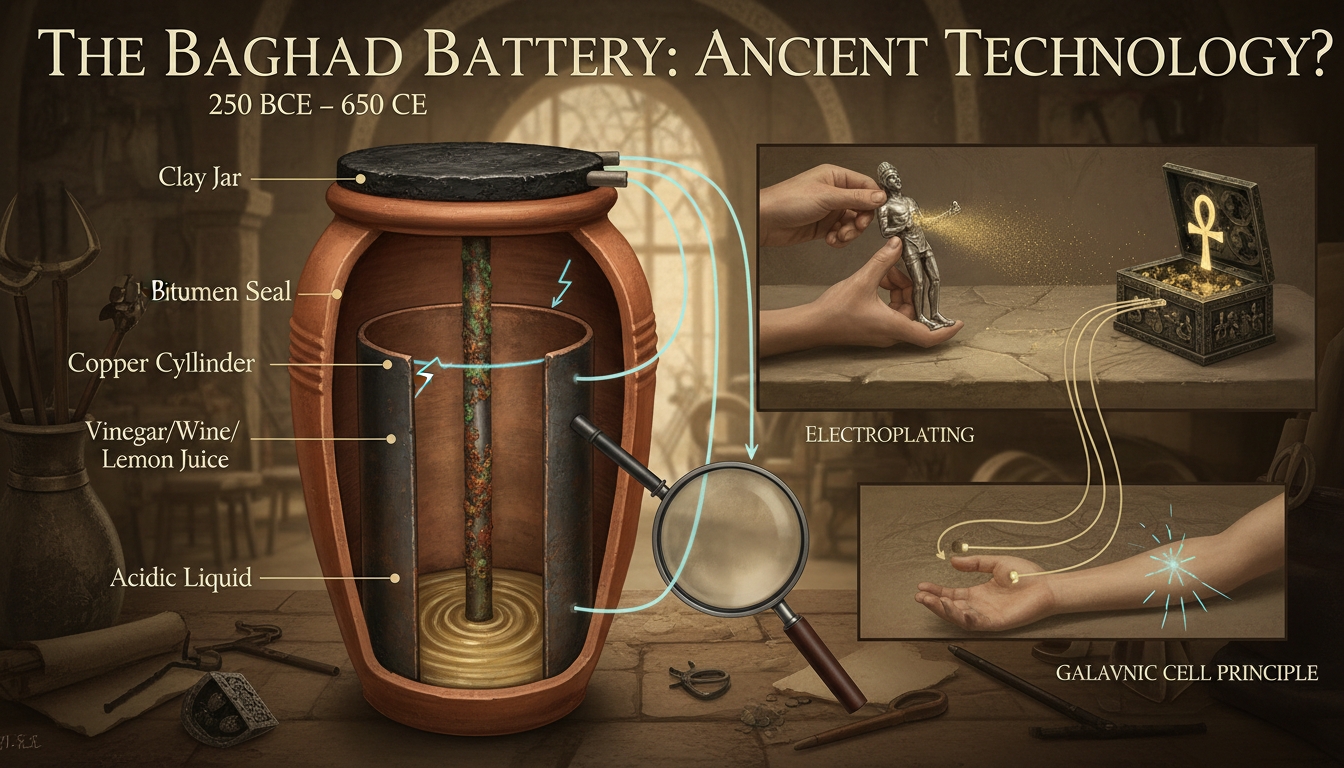
The Baghdad Battery is one of archaeology’s most intriguing and controversial artifacts—often cited as possible evidence of ancient technology far ahead of its time. The relic would be the first known electrical machine from the ancient world.
Discovery and Description of The Baghdad Battery
The Baghdad Battery was discovered in 1936 near Khujut Rabu, close to modern-day Baghdad, Iraq, by German archaeologist Wilhelm König, who later became director of the Iraq Museum. The artifact dates roughly to the Parthian or early Sassanian period (about 250 BCE to 650 CE). The object consists of three main components: A clay jar 5 inches (13 cm) tall to 6 inches (15.24 cm) tall. A copper cylinder fitted inside the jar. An iron rod suspended within the copper cylinder. The jar was sealed with asphalt-like bitumen, which would have made the contents watertight. Notably, the iron rod shows signs of corrosion consistent with exposure to acidic substances.
The Battery Hypothesis
Wilhelm König proposed that the artifact may have functioned as a primitive electric battery. According to this theory, if the jar were filled with an acidic liquid such as vinegar, wine, or lemon juice, a chemical reaction between the iron and copper could produce a small electrical charge—roughly 0.5 to 1 volt. This would make the Baghdad Battery similar in principle to a galvanic cell, the basic concept behind modern batteries.
Possible Uses
Several theories have been proposed regarding what such electricity might have been used for: Electroplating- One of the most popular suggestions is electroplating, where a thin layer of metal (such as gold or silver) is deposited onto another object. Some ancient artifacts from the region appear to have extremely thin and uniform metal coatings, leading some researchers to speculate that electricity could have played a role. Electroplating produces results difficult to achieve with simple hammering or fire-gilding. Low-voltage batteries are sufficient for such processes. This would suggest ancient artisans used electricity without fully theorizing it, much like early metallurgy existed long before chemistry. A single jar isn’t powerful enough to plate a statue. To make this work, ancient people would have needed to connect multiple jars in a series (linking them together with wire) to increase the voltage. If they did this, they could indeed plate small jewelry or coins with a thin layer of gold.
Medical or Religious Purposes- Another hypothesis is that mild electrical shocks could have been used for therapeutic purposes, similar to how ancient cultures used electric fish to treat pain. Alternatively, the sensation of a shock might have been used in religious rituals to create a sense of divine power or mystery. Electric shocks, even mild ones, can cause tingling sensations. Ancient cultures often associated unseen forces with healing or divine power. Electricity might have been perceived as a mystical energy rather than a scientific one. Another possibility is that the device was experimental or symbolic rather than practical—perhaps a curiosity created by skilled metalworkers without a full theoretical understanding of electricity.
The bottom-right image above shows a hand with glowing points, representing a “Galvanic Cell” effect on a human body.
How it works: A galvanic cell is simply a device that converts chemical energy into electrical energy. When your skin touches the leads of a live cell, you feel a “tingle” or a shock. Some researchers believe these were used for electrotherapy or pain relief. By touching the terminals, a patient might feel a numbing sensation.
In a religious context, a priest could have hidden several batteries inside a hollow statue or an “Ark.” When a follower touched the statue, they would receive a “divine shock,” which would have seemed like a supernatural event in 250 BCE.
Skeptical Views
Mainstream archaeologists remain cautious and skeptical of the battery interpretation. Key objections include: No written records describe the use of electricity in ancient Mesopotamia. No wires or associated electrical devices have been found. The object could have served a more mundane purpose, such as a scroll holder, ritual container, or some other religious object holder or a storage vessel. Additionally, many of the supposed electroplated artifacts can be explained using well-known ancient techniques like fire gilding or mercury amalgamation, which do not require electricity.
Experimental Replications
Modern experiments have shown that replicas of the Baghdad Battery can indeed generate electrical current when filled with an acidic solution. However, producing enough electricity for sustained or practical use would likely require multiple units connected together, and no clear evidence of such arrays has been discovered.
Historical Significance and Debate of The Baghdad Battery
Whether or not it was truly a battery, the Baghdad Battery remains significant because it challenges assumptions about ancient technological knowledge. At minimum, it demonstrates a sophisticated understanding of materials, chemistry, and craftsmanship in the ancient Near East. The artifact has become a cornerstone in debates about lost technologies, ancient innovation, and how much knowledge may have been forgotten or misinterpreted over time. Lost or Isolated Knowledge- There is a possibility that this technology: Was known only to a small group of specialists. Was never widely adopted or recorded. Disappeared due to political collapse, secrecy, or loss of skilled artisans. History shows many technologies—such as Roman concrete or Greek fire—were later forgotten despite their effectiveness.
Why It Seems to Be the First Known Electric Battery
It Matches the Basic Design of a Battery. At its core, a battery requires: Two different metals (an anode and a cathode). An electrolyte (an acidic or saline liquid). Iron and copper act as the electrodes. This makes it functionally identical in principle to a modern galvanic cell, such as the batteries invented in the 18th century by Alessandro Volta. The device Predates Modern Electricity by Nearly 2,000 Years. The artifact is usually dated to the Parthian or early Sassanian period (circa 200 BCE – 300 CE). That places it well over a millennium before: Volta’s battery (1800 CE). Formal scientific theories of electricity. If intentional, this would make the battery antiquity the earliest known electrochemical device in history.

Experimental Replications Work
Researchers and engineers have successfully built replicas using the same materials and shapes. These replicas: Produce a steady electric current. Can be linked together to increase voltage. Are capable of powering small electrochemical reactions. The fact that the design works strongly supports the idea that its creators understood—at least practically—how to generate electricity.
Why the Baghdad Battery Is Still Controversial
However, no alternative explanation fully accounts for the specific combination of iron, copper, insulation, and sealing in a way that makes as much functional sense as a battery. Even if it was used only in a limited or experimental way, it stands as a powerful reminder that human ingenuity did not begin in the modern age—and that ancient civilizations may have understood more about the natural world than we often assume.
Current Whereabouts (Original Apparatus)
Here is what’s known about the Baghdad Battery’s location and display today: The original Baghdad Battery device was part of the collection of the National Museum of Iraq (often called the Iraq Museum) in Baghdad, Iraq. It was displayed there along with several similar small jars that some researchers have called ancient galvanic cells. However, the original handset is now considered missing — having disappeared during the widespread looting of the Iraq Museum in April 2003 during the US-led invasion of Iraq. The ancient battery has not been officially recovered, and its precise current location is unknown.
How It Was Displayed
Before 2003: The artifact (and others like it) was exhibited among other archaeological finds from Mesopotamia in the Iraq Museum in Baghdad, where visitors could see the small clay jar with its internal copper cylinder and iron rod. After the Looting: Much of the Iraq Museum’s collection was stolen or displaced. Some items have been recovered over the years, but many — including the Baghdad Battery — remain lost or potentially held privately or on the illicit art market.
Museum Status and Context
The Iraq Museum itself, which houses Mesopotamian, Abbasid and Persian artifacts, was closed for some years after 2003 but has since reopened and undergone restoration, although its holdings and displays changed due to losses and repatriations. In summary: The original Baghdad Battery artifact was displayed in the National Museum of Iraq in Baghdad but has been missing since the 2003 looting. Its exact location now is unknown and the item is not currently on public display.
Conclusion
The Baghdad Battery stands at the intersection of archaeology and mystery. While definitive proof of its use as an electrical device remains elusive, its unusual construction ensures it will continue to inspire speculation, experimentation, and debate. Whether an ancient battery or a misunderstood artifact, the notion reminds us that the ancient world may still hold surprises that challenge modern expectations. The Baghdad Battery is fascinating because the situation appears to show that people in the ancient world may have understood and harnessed electricity nearly two thousand years before modern science officially “discovered” it. Whether the item truly functioned as a battery or not, the object challenges assumptions about the technological limits of ancient civilizations. We hope the ancient Baghdad battery will be found intact and then returned to its home: the Iraq Museum in Baghdad from which it was stolen from.