The Antikythera Mechanism is one of the most remarkable archaeological discoveries ever made, often described as the world’s first analog computer. It was found in 1901 in a shipwreck near the Greek island of Antikythera and dates back to around 100 BCE. At first glance it looked like a lump of corroded bronze, broken into fragments, but scientists later realized it contained a complex system of gears unlike anything else known from the ancient world. At first, no one paid much attention to it—it looked like scrap metal compared to the dramatic statues. However, in 1902, archaeologist Valerios Stais noticed something extraordinary: Inside the corroded bronze were precisely cut gear teeth.
The object clearly wasn’t decorative or random. It appeared to be some kind of mechanical device. This was shocking because such complex gear systems were thought to have been invented more than a thousand years later. It had been part of a Greek ship traveling from the eastern Mediterranean, likely carrying luxury goods. The gears were designed with mathematical precision. Over time, researchers realized the object was a kind of astronomical calculator—used to predict: Solar and lunar eclipses. Planetary movements. Calendar cycles. Important athletic events like the Olympic Games. This led to it being called the Antikythera Mechanism, named after the island where it was found. The Antikythera device (often called the Antikythera mechanism) is amazing because it shows that people well over 2,000 years ago had technology far more advanced than scientists ever expected. It is a complex set of bronze gears discovered in 1901 inside a shipwreck near the Greek island of Antikythera. The ship sank around 100 BCE. At first it looked like a lump of corroded metal, but researchers later realized it was a precision scientific instrument.
The Antikythera Mechanism was built to predict astronomical events.
By turning a hand-crank, a user could model the movements of the Sun, Moon, and the movements of planets (as they were known then). It could track eclipses, show the phases of the Moon, calendar cycles including leap years, and follow long-term cycles such as the Metonic cycle, which links lunar months to solar years. Inscriptions on the device suggest it was also used to calculate the timing of important events like the Olympic Games.
What makes the Antikythera Mechanism so extraordinary is its technological sophistication. It used dozens of precisely cut bronze gears arranged in a compact box, a level of mechanical engineering not thought to exist until medieval clockmaking over a thousand years later. This discovery forced historians to rethink what ancient Greek scientists and engineers were capable of achieving.
The Antikythera device is amazing because it proves that ancient humans could build machines as intellectually complex as anything before the modern age—and they did it with hand tools, math, and pure genius. It was far ahead of its time. Before its discovery, scientists believed: Complex gear systems appeared around 1400 CE. Ancient Greeks didn’t use precision mechanics. The Antikythera device proved this was wrong by more than 1,000 years. Extreme engineering precision. Gears were cut with incredible accuracy. Some gears used complex ratios to match real astronomical cycles. One gear system accurately predicted eclipse patterns using the Saros cycle. This required advanced math, astronomy, and craftsmanship. No other device like it survives from antiquity.
This suggests there may have been an entire tradition of advanced machines. That knowledge likely disappeared after political collapse and loss of learning centers. The device forced historians to rethink: Ancient Greek science. The origins of mechanical engineering. how sophisticated early civilizations truly were.
Today, the Antikythera Mechanism is seen as powerful evidence of advanced scientific knowledge in ancient Greece. Although only fragments remain, modern imaging techniques have helped researchers reconstruct how it worked. The device stands as a reminder that ancient civilizations were far more inventive and technologically advanced than we often assume.
The Antikythera device is fascinating because it proves that ancient humans could build machines as intellectually complex as anything before the modern age—and they did it with hand tools, math, and pure genius.
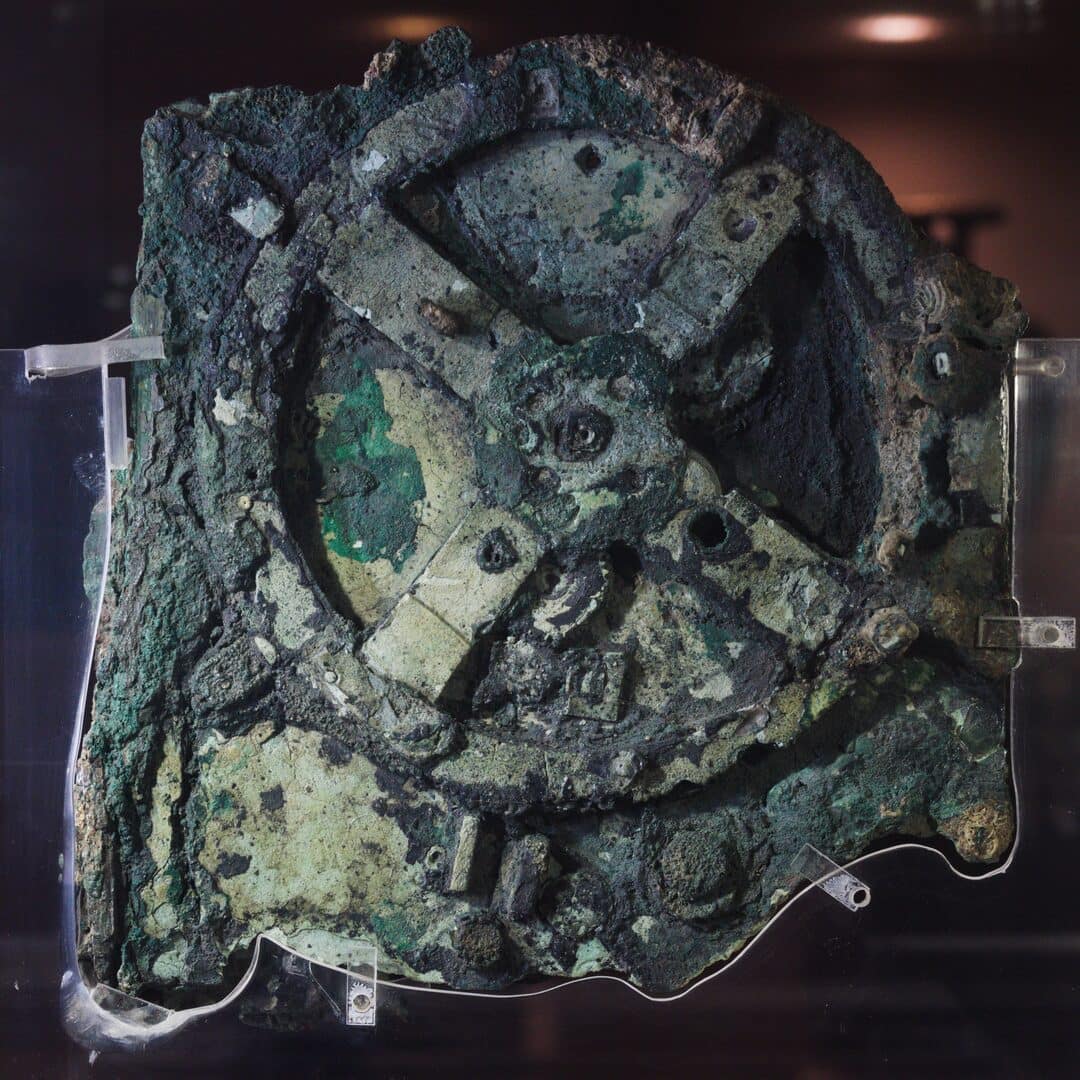
Discovery:
The Antikythera Mechanism was discovered by accident in the early 20th century, and its story is one of the most fascinating archaeological finds in history. In the spring of 1900, a group of Greek sponge divers from the island of Symi were sailing through the Aegean Sea. On their way to North Africa, a storm forced them to seek shelter near the small, rocky island of Antikythera, which lies between Crete and mainland Greece.
While waiting for the weather to improve, one of the divers, Elias Stadiatis, decided to dive into the nearby waters to look for sponges. Using heavy copper diving suits and helmets (standard at the time), he descended about 45 meters (150 feet) to the seabed. Instead of sponges, he saw something completely unexpected: Bronze and marble statues. Human figures scattered across the seafloor. What looked like a shipwreck. When Stadiatis surfaced, he excitedly reported seeing “dead bodies” underwater—he meant statues, but the description alarmed his crew at first.
Realizing the importance of the discovery, the divers reported it to Greek authorities. The Greek government, with help from the Hellenic Navy, organized an official salvage operation—one of the earliest underwater archaeological excavations ever conducted.
Between the late 1900 and 1901: Divers recovered statues, pottery, glassware, jewelry, and coins. Many objects were damaged due to rough seas and the limits of early diving technology. At least one diver died, and others suffered decompression sickness, highlighting how dangerous the work was. The artifacts were transported to the National Archaeological Museum in Athens.
How did it work?
The machine worked like a hand-powered mechanical calculator. Gears and hand crank. It contained dozens of interlocking bronze gears. Turning a hand crank moved the gears together. Each gear represented a mathematical cycle of the sky. The front and back had circular dials. Pointers showed positions of the Sun, Moon, and possibly planets. Greek inscriptions explained how to read the results. In simple terms, it was an ancient analog computer that modeled the universe.
The Oldest Known Computer
Some researchers now call it: “The world’s first known computer.” What is an analogue computer? An analogue computer is a device that represents and solves problems using continuously varying physical quantities, rather than discrete numbers like 0s and 1s. Instead of doing calculations by counting or symbolic math, it models a real system directly. Common ways analogue computers work include: Angles and rotations (e.g., gears, dials). Lengths or positions (e.g., sliders). Voltages or currents (in later electronic analogue computers). When you change the input (for example, turn a knob), the output changes smoothly and proportionally, mirroring how the real-world phenomenon behaves. Examples: A slide rule (uses lengths to represent numbers). A mechanical tide predictor. Early electronic analogue computers used for flight simulation.
Historians and scientists use this description for several key reasons: It performed calculations, not just measurements. The device didn’t merely display the time or show the stars. When a user turned a crank, the gears calculated future astronomical events, including: Positions of the Sun and Moon. Lunar phases. Solar and lunar eclipses. Cycles of the Olympic Games and other calendars. This goes beyond a simple instrument—it processed input to produce computed output.
It used physical analogies to model real systems. The Antikythera mechanism is analogue because: Gear rotations represented astronomical cycles. Different gear ratios matched known celestial periods (e.g., the Metonic cycle of 19 years). The motion of the gears directly mirrored the motion of celestial bodies. In other words, the machine physically modeled the mathematics of the heavens.
The ancient instrument handled multiple variables at once. The device combined: Solar cycles. Lunar cycles. Eclipse prediction cycles. Calendar systems. All of these were mechanically linked, allowing one input motion to update many outputs simultaneously—exactly what we expect from a computer.
The machine produced predictive results. A key feature of a computer is prediction. The Antikythera mechanism could: Show when an eclipse would occur. Indicate what type of eclipse (solar or lunar). Track long-term astronomical cycles decades into the future. This makes it computational, not decorative. Its complexity was unmatched for over a millennium.
People call the Antikythera mechanism the first and oldest known analogue computer because it: Performed real calculations. Modeled complex natural systems. Used continuous mechanical motion. Produced predictive, multi-variable outputs. Predates all other known computing machines by over a thousand years. It shows that advanced scientific computing existed in ancient Greece, far earlier than once believed. No other known device with: Comparable gear complexity. Mathematical sophistication. Scientific purpose appears again until medieval astronomical clocks (14th century CE). That gap strongly supports its status as the earliest known analogue computer.
Why “analogue” specifically, not digital?
The Antikythera Instrument did not count using discrete steps or symbols. It used continuous motion and ratios. There was no stored program or binary logic. The answers emerged from the physical behavior of the machine itself, which is the defining trait of analogue computing.
Why researchers still study the Antikythera Mechanism working artifact today.
New imaging techniques (like X-ray scans) keep revealing hidden details. Scientists are still debating exactly how many planets it tracked. It helps us understand how ancient people viewed the cosmos.


Keep this going please, great job!
Thanks for sharing your thoughts about website. Regards