Edgar Cayce (1877–1945) was an American psychic and spiritual teacher who became famous for entering a sleep-like or trance state and giving what he called “readings.” His followers credited him with providing information about illnesses, treatments, past lives, dreams, and other subjects.
Cayce became known as the “Sleeping Prophet.” The central scientific question surrounding Cayce is whether his apparent ability to obtain information while in a trance can be demonstrated as a genuine phenomenon under controlled, repeatable conditions.
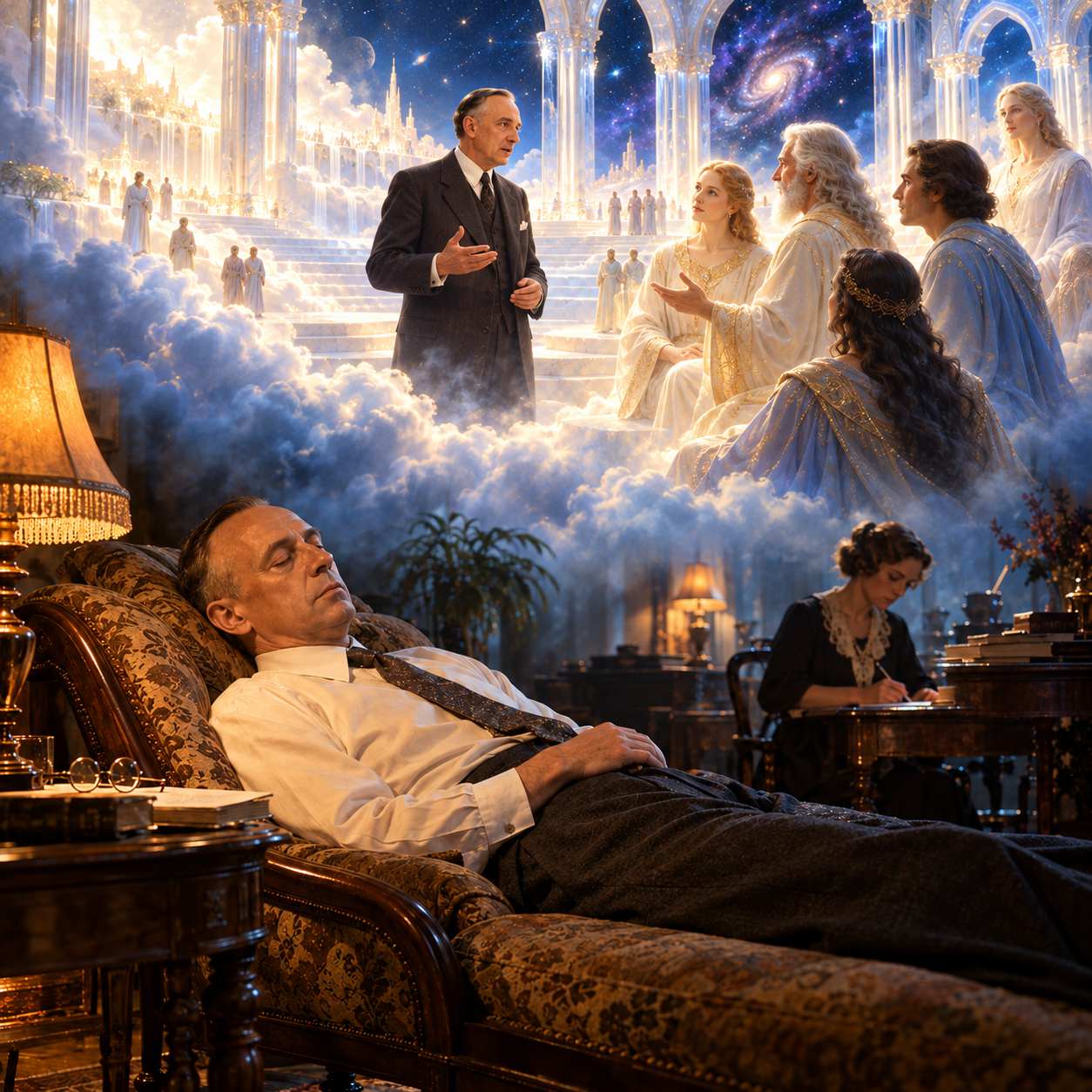
Who Was Edgar Cayce? Cayce was born in Kentucky in 1877 and became interested in healing after experiencing difficulties with his own health. According to accounts of his life, he discovered that he could enter a trance-like state and supposedly describe medical problems and suggest treatments. During a typical reading, Cayce would lie down, close his eyes, and enter what witnesses described as a sleep-like condition. He would then reportedly answer questions presented to him.
Many of the readings concerned people who were not physically present. Cayce eventually conducted thousands of readings. His followers preserved transcripts of these sessions, many of which are now held by the Association for Research and Enlightenment (A.R.E.), the organization founded around his work.
Cayce’s Medical Readings: The medical readings are among the most important parts of Cayce’s reputation. He reportedly described symptoms, illnesses, and physical conditions and sometimes recommended dietary changes, exercises, herbal preparations, massage, hydrotherapy, or other treatments.
Some followers have claimed that certain recommendations were remarkably accurate or ahead of their time. These accounts are frequently presented as evidence that Cayce possessed unusual abilities.
Science, however, requires more than individual successful cases. A medical claim must be tested systematically against appropriate controls and alternative explanations. A person can make many predictions or recommendations and have some appear correct purely by chance.
In addition, illnesses sometimes improve naturally, symptoms can fluctuate, and patients may remember successful predictions more readily than unsuccessful ones.
Modern science generally requires that an extraordinary claim be tested under conditions designed to eliminate ordinary sources of information. Investigators would ideally need to prevent the subject from obtaining information through conversation, observation, documents, previous knowledge, or subtle cues.
The results would also need to be independently replicated by other investigators. Cayce’s readings generally occurred in circumstances that were not designed according to modern experimental standards. Consequently, his historical records cannot easily establish whether his information came from a paranormal source.

The Problem of Verification. A major difficulty is determining exactly how accurate Cayce’s readings were. Thousands of readings provide a large amount of material from which apparently successful examples can be selected.
But a scientific evaluation would need to examine all relevant predictions, including incorrect, vague, and unsuccessful ones. This is particularly important because statements can sometimes be interpreted in different ways after an event has occurred.
For example, a statement that appears mysterious before an event might seem very precise afterward because people naturally connect it with something that happened. This is sometimes called retrospective interpretation. Scientists therefore prefer predictions that are recorded clearly before the outcome is known and can be evaluated according to predetermined criteria.
The Possibility of Ordinary Explanations. There are several possible explanations for apparently remarkable psychic readings that do not require paranormal abilities. One is prior knowledge. Cayce may have known more about a person or situation than later accounts suggest.
Another possibility is general medical knowledge. Some conditions produce recognizable combinations of symptoms, and a knowledgeable person can sometimes make surprisingly accurate inferences without knowing all the details.
Another explanation is chance. When thousands of statements are made, some will inevitably turn out to be correct. There is also the possibility of selective reporting. Successful readings may be remembered and circulated more often than unsuccessful ones.
None of these explanations necessarily proves that every Cayce reading was ordinary. Rather, they demonstrate why controlled testing is necessary before concluding that a paranormal ability was involved.
Cayce and Predictions About the Future. Cayce also became associated with predictions concerning future events.
Some of his followers have attributed predictions about geological changes, political events, economic conditions, and other developments to him.
Scientific evaluation is especially difficult in this area because predictions sometimes have uncertain wording or dates. A prediction can also be interpreted in multiple ways after an event occurs.
For a prediction to provide strong scientific evidence, it would ideally have to be clearly stated; recorded before the event; sufficiently specific; unlikely to occur by chance; objectively measurable; and successfully repeated. Cayce’s predictions generally do not meet all of these requirements.
The Question of Scientific Evidence. There is an important distinction between historical evidence and scientific evidence.
There is considerable historical evidence that Edgar Cayce conducted readings and that many people sincerely believed he possessed unusual abilities.
His organization preserved thousands of records, and numerous individuals reported experiences that they considered extraordinary. That establishes that Cayce was a historically significant figure and that people had experiences they regarded as paranormal.
It does not, by itself, establish that Cayce possessed a scientifically demonstrated psychic ability. Scientific evidence requires controlled observation, measurement, statistical analysis, and replication.

Did Science Prove Cayce Was a Fraud? The absence of scientific proof does not automatically prove that Cayce deliberately deceived people. There is an important difference between saying “his paranormal abilities have not been scientifically demonstrated” and saying “he knowingly fabricated everything.”
The first is a statement about the evidence. The second is a claim about Cayce’s intentions and behavior and would require separate evidence. Cayce’s sincerity is therefore a different question from whether his abilities were paranormal.
It is possible for someone to sincerely believe that unusual experiences have a supernatural explanation while the experiences themselves have an ordinary explanation.
Why Cayce Remains Interesting to Researchers: Cayce remains an interesting subject because his case raises broader questions about human consciousness, intuition, suggestion, memory, expectation, and unusual experiences.
Science has investigated several related areas, including hypnosis, altered states of consciousness, placebo effects, unconscious information processing, and the ways people can make surprisingly accurate judgments without consciously knowing how they arrived at them.
These subjects demonstrate that human mental processes can sometimes be complicated and poorly understood without requiring a paranormal explanation. That does not establish that Cayce’s claims were impossible. It means that a scientific conclusion requires evidence specifically demonstrating a paranormal mechanism.
Cayce’s Place in Science: Edgar Cayce is not generally regarded by mainstream science as having established a scientifically verified psychic ability.
His enormous collection of readings provides historical material that can be studied, but the readings were not produced under the rigorous experimental conditions normally required to establish paranormal phenomena.
Consequently, Cayce occupies a position primarily within the history of American spirituality, psychic phenomena, alternative healing, and paranormal culture rather than within established scientific medicine or psychology. His supporters regard the accuracy of some readings as evidence of extraordinary abilities.
Skeptical interpretations emphasize chance, selective reporting, prior information, inference, subjective interpretation, and the absence of controlled experimental verification.
Conclusion: Edgar Cayce remains one of the most famous American figures associated with psychic phenomena.
His thousands of readings, especially his medical readings, have led many people to believe that he possessed an unusual ability to obtain information through a trance state.
From a scientific standpoint, however, the crucial issue is not simply whether some of his statements appeared accurate.
The question is whether those results can be demonstrated under controlled conditions and independently reproduced. That standard was not established for Cayce’s readings.
Therefore, science has not established that Edgar Cayce possessed genuine precognitive or paranormal abilities.
At the same time, the lack of scientific verification is not, by itself, proof that every account associated with Cayce was deliberately fraudulent.
His case remains a historical example of a highly influential psychic whose claims have generated continuing debate between believers and skeptics.
And Cayce gave thousands of past-life readings for individuals which cannot be scientifically verified, since reincarnation itself has not been proved scientifically; and his past-life readings are not even historically proven as accurate or precise.