Cape Girardeau is a principal city in Cape Girardeau County and Scott County in the USA state of Missouri. The city is the economic center of southeastern Missouri, and the home of Southeast Missouri University. The alleged Cape Girardeau UFO crash of 1941 is one of the oldest and most controversial stories in American UFO lore. If the event actually occurred as described, it would have taken place six years before the famous June 4th to July 10th 1947 Roswell, New Mexico UFO crash incident, making it one of the earliest claimed UFO crash-retrieval cases in the United States. However, there is no physical evidence or contemporary documentation confirming the event, and historians generally regard it as an unverified legend.
According to the legend, the incident occurred in April or June 1941 in a rural area outside Cape Girardeau, Missouri. The central figure is Reverend William G. Huffman, a Baptist minister of The Red Star Baptist Church. According to accounts that surfaced decades later, Huffman received a late-night request from local authorities to travel to what he believed was an airplane crash so he could pray over; administer last rites to the victims. When he arrived, police officers, military personnel, and plainclothes officials were already present.
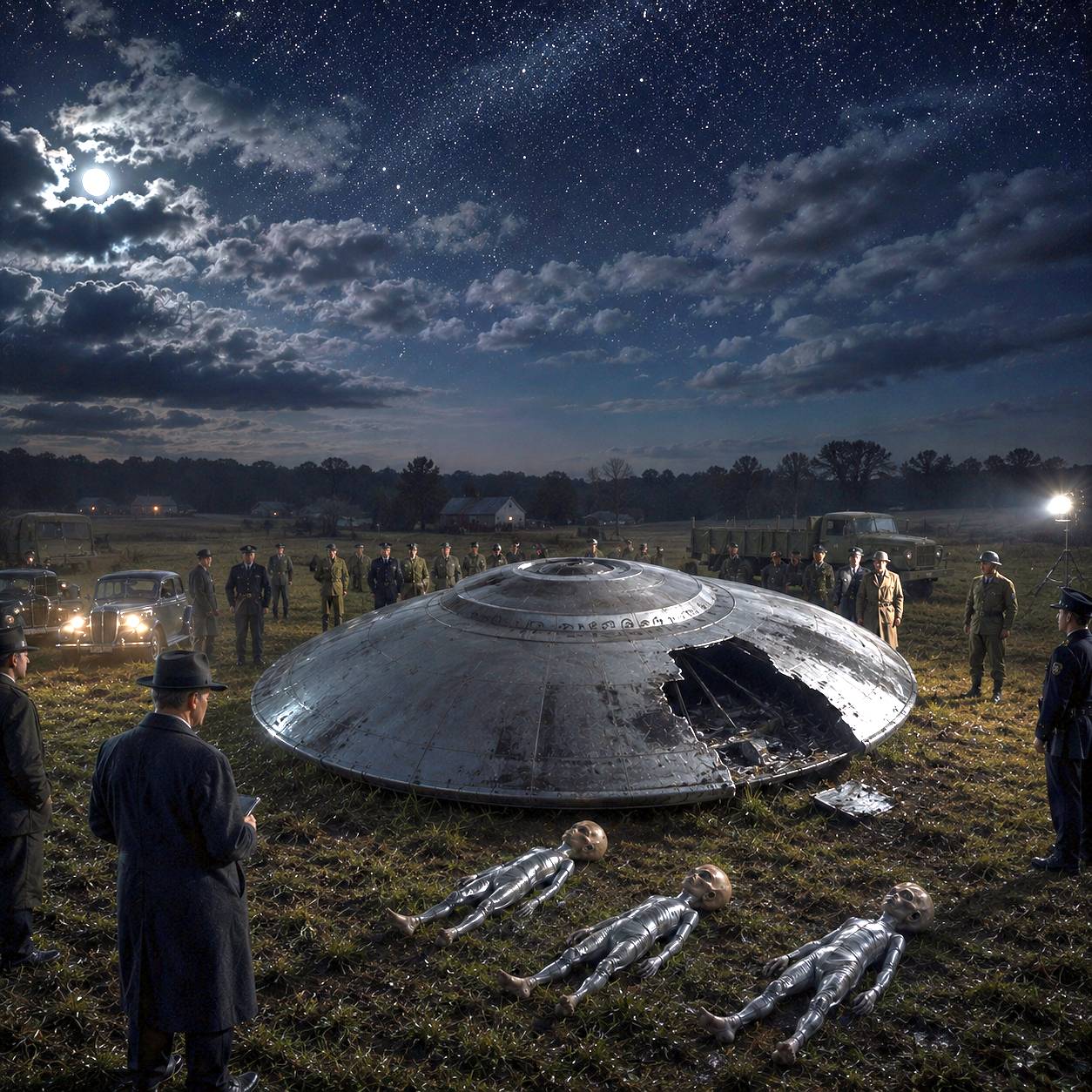
The story says he found something entirely unexpected. Instead of a conventional aircraft, witnesses later claimed there was a disc-shaped metallic craft lying on the ground. Which years later would be called a “flying saucer”. Nearby the wrecked craft were three small humanoid dead bodies. According to later re-tellings, the corpses were said to be: About 4 feet (1.2 meters) tall. Hairless. Possessing unusually large heads. Having large eyes. Small mouths. Thin arms and legs. Wearing what appeared to be a seamless and tight metallic suit. Some versions claim strange; unrecognizable hieroglyphic-like symbols or writings were visible inside or on parts of the craft.
The Military Arrives
According to the legend, military personnel soon arrived and secured the crash site. Witnesses were allegedly instructed never to discuss what they had seen. One frequently repeated part of the story claims a military photographer secretly gave Reverend Huffman a photograph showing him standing beside one of the bodies. The photograph has never been produced publicly.

How the Story Became Public
One reason the case remains controversial is that no reports from 1941 describing the event have been found. Instead, the story first entered UFO literature decades later. In the early 1990s, UFO researcher Leonard Stringfield published an account after receiving information from Charlette Mann, Reverend Huffman’s granddaughter. She said her grandfather privately told the family about the extraordinary incident shortly before his death and had remained silent for many years because of alleged government pressure.
Leonard H. Stringfield is one of the best-known figures in UFO research, particularly for his investigations into alleged UFO crash-retrieval cases. Although he did not claim to have personally witnessed the alleged 1941 Cape Girardeau incident, he was the first researcher to publish it in detail, bringing the story to the attention of the UFO community. Stringfield (1920–1994) served in the U.S. Army Air Forces during World War II and became interested in flying saucers shortly after the war. During the 1950s he was associated with the civilian UFO research organization CRIFO (Civilian Research, Interplanetary Flying Objects). Later, he became famous for a long series of reports investigating claims that the U.S. military had recovered crashed UFOs and non-human bodies. Rather than insisting every story was true, he generally presented witness testimony and discussed its strengths and weaknesses.
According to Stringfield, the story reached him through another respected UFO researcher, Raymond E. Fowler. In the late 1980s or about 1990, Fowler received a letter from Charlette (or Charlotte) Mann, a woman whose grandfather had allegedly witnessed an extraordinary event in 1941. Fowler believed Stringfield would be especially interested because he was collecting reports of crashed UFOs, so he forwarded the letter to him. Stringfield then contacted Mann directly. He interviewed her by telephone and asked her to prepare a more detailed written account of what her grandfather had told the family over the years.
When Stringfield published the case
Stringfield first published the Cape Girardeau story in July 1991. It appeared in Status Report VII: UFO Crash/Retrievals – The Inner Sanctum, one installment of his well-known UFO Crash/Retrievals report series. This was not a mass-market magazine article but a special research publication distributed primarily among UFO investigators and interested readers. The publication included: Charlette Mann’s letter. Stringfield’s personal comments including that Mann’s story could be true, even though there was no real proof. His assessment is that the report deserved preservation because it fit the pattern of other alleged crash-retrieval accounts he had collected.

Why Some People Believe It
Supporters point to several factors: The account predates the Roswell incident by six years. Reverend Huffman was reportedly considered an honest and respected minister. The family’s version of the story remained fairly consistent over time. Later researchers attempted to identify possible officials and locations that might match the narrative. No evidence about a fraud or a hoax regarding the story ever surfaced to the public, even after eighty five years, 2026, the year of this online article.
Reasons for Skepticism
Most historians and many UFO researchers remain unconvinced because: There are no official police, military, or newspaper reports from 1941 describing such a crash. No wreckage or artifacts have ever been recovered. The famous alleged photograph has never surfaced. The principal account is secondhand, based on what Reverend Huffman’s granddaughter said he privately told family members years later. The story only became widely known roughly fifty years after the alleged event.
Countering The Skeptics
The important thing to remember is that the federal government, at least, wanted the whole incident to be keep secret and ordered a big “hush up”. There would also be severe penalties for anyone who would speak about the matter which can include instant arrest and jailing. In some cases, UFO talkers, allegedly claimed, without any proof, many, many years later, to have been threatened with “disappearing and would never by found” by military authorities as punishment for not remaining silent. So naturally there is going to be no government reports publicly known about the UFO crash with dead aliens, nor wreckage or artifacts publicly recovered, no UFO photograph; no extraterrestrials photograph publicly surfacing, and a private family member story about a crashed flying disk and dead aliens taking about fifty years to be mentioned publicly when there finally seemed to be a safe time to do so.
Legacy
Despite the lack of conclusive evidence, the Cape Girardeau case has become one of the most discussed alleged UFO crash stories before Roswell. It has inspired books, documentaries, podcasts, and continuing debate within the UFO community. Some researchers refer to it as the “First Roswell,” while skeptics view it as a compelling local legend that cannot be verified. Whether the event represents a genuine, hidden historical incident or a story that grew over time remains unresolved. At present, there is no verified evidence that extraterrestrial beings or a crashed spacecraft were recovered near Cape Girardeau in 1941. But, there might be an official government file in highly protected storage on the strange occurrence that is highly classified and marked as “top secret”.